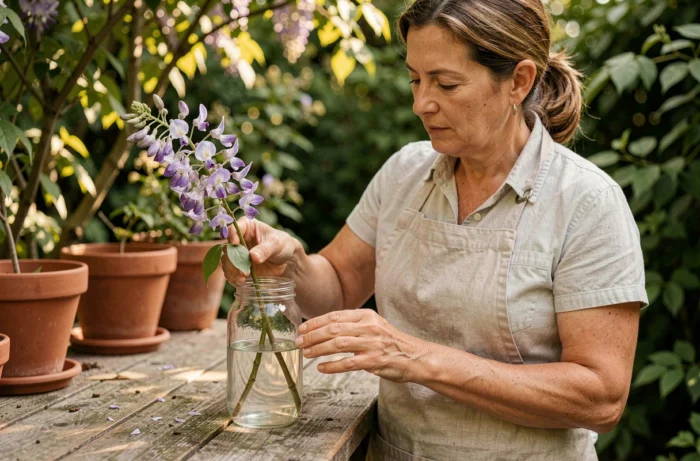
A stem of wisteria plunged into a glass of water on the windowsill is tempting. The gesture seems simple, almost obvious. However, propagating wisteria in water remains a capricious method, far less reliable than rooting in draining substrate.
The semi-woody stems of this climbing plant do not tolerate prolonged immersion well and can easily rot. This technique works, but it requires close monitoring and some precautions that traditional soil propagation does not demand.
Wisteria in water or in substrate: why the difference matters
You may have noticed that a mint stem forms roots in a glass within a few days? Wisteria does not react in the same way at all. Its semi-woody stems, harder and less waterlogged than those of herbaceous plants, absorb moisture slowly. In total immersion, the base of the cutting lacks oxygen and begins to blacken.
The draining substrate remains the reference method for woody cuttings. A mixture of sand and peat, for example, provides both moisture and air circulation around the stem. Immersion can serve as a quick test to observe the appearance of roots, provided the water is changed very regularly.
If you are looking for tips for propagating wisteria in water, keep in mind that this approach requires more vigilance than a simple pot of moist soil. The main risk is rot, not a lack of roots.
Choosing the stem: what determines the success of propagation
The choice of the stem determines almost the entire outcome. Take a bad segment, and no trick will save it.
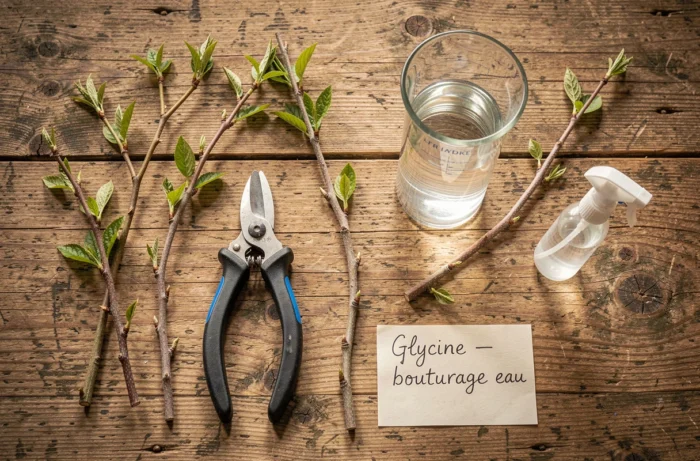
Look for a semi-woody stem, meaning neither completely green nor fully woody. When gently bent, it should resist a bit without breaking cleanly. This stage of maturity is usually found on the shoots of the year, at the end of spring or the beginning of summer, when the wisteria is in full growth.
- Ideal length: a segment with at least three or four nodes (the small swellings from which the leaves emerge), providing a stem of sufficient size for one or two nodes to be submerged.
- Clean cut just below a node, using disinfected pruning shears. It is at the node that the cells responsible for root formation are concentrated.
- Remove the leaves from the lower part (the part that will be in the water) and keep only one or two leaves at the top to maintain a minimum of photosynthesis.
A stem that is too young will rot, a stem that is too old will not root. The right segment lies between the two, and it is often a matter of touch as much as sight.
Wisteria propagation in water: the concrete steps to follow
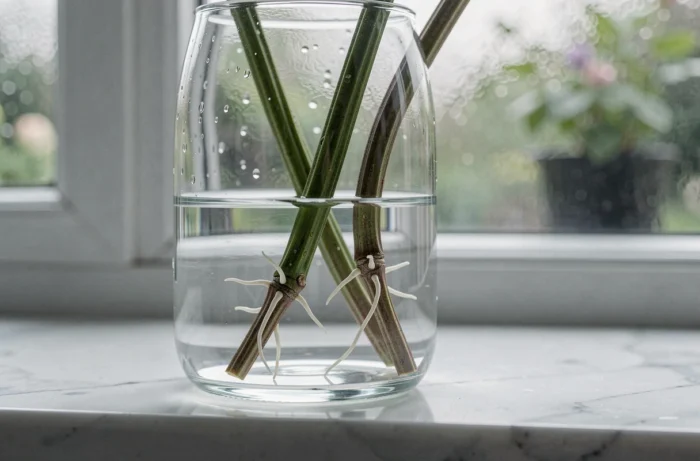
Use a transparent container to monitor the condition of the base and the appearance of roots. A simple glass or a small glass jar will do. Avoid opaque containers that prevent you from seeing the onset of rot.
Fill the container with room temperature water. Tap water is fine if it is not too chlorinated. Let it sit overnight before use to allow the chlorine to evaporate.
Daily care for the submerged cutting
This is where the aquatic method becomes demanding. Change the water every two to three days, without exception. Stagnant water quickly becomes a favorable environment for bacteria, and the stem will brown in a few days. If you notice a cloudy film or an odor, change it immediately.
Place the container in a bright location, but out of direct sunlight. Bright light heats the water and accelerates bacterial proliferation. An east or north-facing window works well.
Rooting hormone: useful or optional?
Dipping the base of the stem in rooting hormone powder before placing it in water can improve rooting chances. The powder partially dissolves upon contact with water, but the node retains enough to stimulate root formation. This is not mandatory, but on a plant as reluctant to water as wisteria, rooting hormone significantly increases the success rate.
Signs of success and transition to soil
After several weeks of patience, small white growths appear at the submerged nodes. These are the first roots. Wait until they measure a few centimeters before transplanting: roots that are too short will not survive the shock of repotting.
Do not leave the cutting in water too long after the roots appear. Roots formed in water are fragile and poorly branched. The longer you wait, the more difficult the transition to soil will be. A quick transfer to a pot filled with a light mix (potting soil and sand) allows the roots to gradually adapt to a more aerated environment.
Keep the substrate moist without overwatering during the first few weeks. Place the pot in partial shade. The young cutting does not need intense sunlight at this stage.
Flowering of a propagated wisteria: what to know before getting started
A clear advantage of propagation over seeding: the new plant retains the exact characteristics of the mother wisteria. Cluster color, fragrance, vigor, everything is reproduced identically. Seeding, on the other hand, can produce a plant that will take much longer to flower, with unpredictable results.
However, a propagated wisteria does not flower in the first year. Several growing seasons are needed before the first clusters appear. If your main goal is to quickly obtain a flowering wisteria, purchasing a named cultivar already of flowering age remains the most direct route.
One last often-overlooked point: Asian wisterias are described as very vigorous, even invasive in some regions. Multiplying a wisteria by cutting also means taking responsibility for managing its growth in the long term. Plan for a sturdy support and regular pruning, otherwise the plant will colonize everything within its reach.