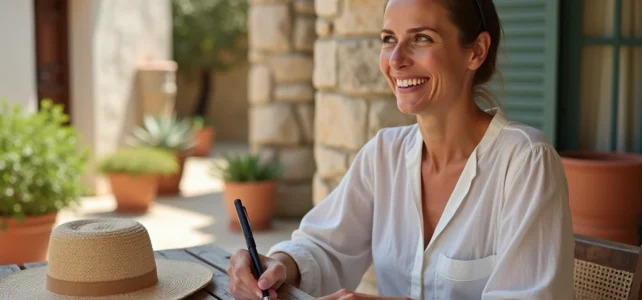
Sending a holiday card remains a simple gesture that retains its significance. Finding the right words for a free holiday card poses a real challenge: too short, the message seems rushed; too long, it loses spontaneity. The question of the text deserves more attention than the choice of visuals.
Structure in three sentences: the method that avoids hollow messages
Most websites offer lists of ready-to-copy texts. The result is often generic, interchangeable from one recipient to another. A more effective approach is to build your message around three specific sentences.
The first sentence sets the scene: the destination and a concrete feeling. “The mistral blows over the calanques and the water is an unreal blue” works better than “It’s nice here.” The second sentence describes what you are experiencing or doing. The third conveys a sincere thought to the recipient, not a generic phrase.
This structure fits within three to six lines. It produces a personal text without requiring any particular literary talent. Sending a pretty free holiday card accompanied by such a message changes the recipient’s perception compared to a simple “Kisses from Brittany.”

Ideal length of a holiday card text
Specialized guides in handwriting recommend a message of between 50 and 80 words for a postcard. This range corresponds to a limited physical space (the front of a standard card) and a reading time of a few seconds.
For a virtual card, the space constraint disappears, but the logic remains the same. A text that is too long on a phone screen will be skimmed or ignored. The most shared messages often fit into a single vivid sentence.
The single sentence format
“This card is small, but the sun it contains is immense” illustrates this style well. A single sentence is enough when the image is strong. This format is particularly suitable for cards sent via messaging or on social networks, where brevity is key.
On the other hand, for a card addressed to a close person with whom the relationship is strong (grandparents, childhood friend), the three-sentence format adds a more personal dimension. The choice depends on the relationship with the recipient, not a universal rule.
Examples of texts according to the recipient
The tone of a holiday message varies depending on the person receiving it. Here are some concrete suggestions for three common situations.
- For a close friend: focus on a shared memory or a playful joke. “We found the perfect beach, all that’s missing is you and your broken umbrella from last year. See you soon.” The personal connection gives the text its value, not the superlatives.
- For a colleague: keep it light and short. “Greetings from the Basque coast, I’m thinking of you between two waves (I promise, not too many). Have a great summer, everyone.” The professional yet relaxed tone avoids inappropriate familiarity.
- For a grandparent or parent: include a concrete detail from the trip and a loving thought. “We visited a small perched village this morning, you would have loved the flower-filled streets. We’re thinking of you, big hugs.” Visual details allow the recipient to envision the experience.

Free virtual card: what changes in the text
On a physical postcard, the text coexists with the stamp, the address, and sometimes a drawing. The constrained space requires conciseness. On a virtual card, the visual often occupies the entire screen, and the text appears as an overlay or in a separate field.
The text of a virtual card must work without the visual. If the message says nothing without the image, it misses its target. Free card platforms offer generic visuals (beach, mountain, sunset). The personal text is the only element that distinguishes your sending from a standard card.
Adapting the message to the sending channel
A card sent by email allows for a slightly longer text than a card shared via WhatsApp. On instant messaging, the natural limit is around two or three lines visible without scrolling.
- By email: the recipient opens the card in a calm context, a text of four to six sentences works well.
- By WhatsApp or SMS: favor a striking sentence or a very short format, the message will be read in a few seconds between two notifications.
- On a social network (story, post): the text often boils down to a caption. A catchy phrase or a quote is enough.
Avoiding clichés that sound insincere on a holiday card
Some phrases appear on all cards and end up saying nothing. “Enjoy,” “Rest well,” “Soak up the sun” are more writing reflexes than messages.
A text gains sincerity when it contains a true detail. Naming a place, an activity, a dish tasted, an anecdote from the journey. A concrete detail is worth ten ready-made phrases. “We missed the ferry this morning, so we discovered a deserted cove” tells more than “We’re having a great holiday.”
The opposite trap also exists: trying to be literary at all costs. A holiday card is not a style exercise. The simplicity of the message, when precise, touches more than embellishment.
Writing a holiday card text takes less than five minutes with the three-sentence method. The sincere detail and the tone adjusted to the recipient make the difference between a forgotten message and a preserved one.