
The beige suit poses a colorimetry question that darker shades (navy, anthracite, black) avoid: its high brightness amplifies every tonal deviation with the tie. Choosing the right tie color for a beige suit therefore involves measuring the necessary contrast based on the context, the exact shade of beige, and the shirt worn underneath.
Contrast and Color Temperature: The Technical Framework of the Beige Suit
Beige falls within warm and light tones. Any dark tie (navy, burgundy, black) creates a strong contrast, while a tie in similar tones (tobacco, sand, camel) produces a tonal, almost monochrome effect. Neither is inherently better: it all depends on the level of formality intended.
A lighter sand beige suit can support more contrast without appearing unbalanced. A dark or camel beige, on the other hand, better absorbs ties in close shades like chocolate brown or olive green.
To find advice on Absolutis, the logic remains the same: start with the temperature of the beige (warm golden or warm pink) and pair it with a tie that stays within the same thermal family or deliberately diverges to emphasize the contrast.
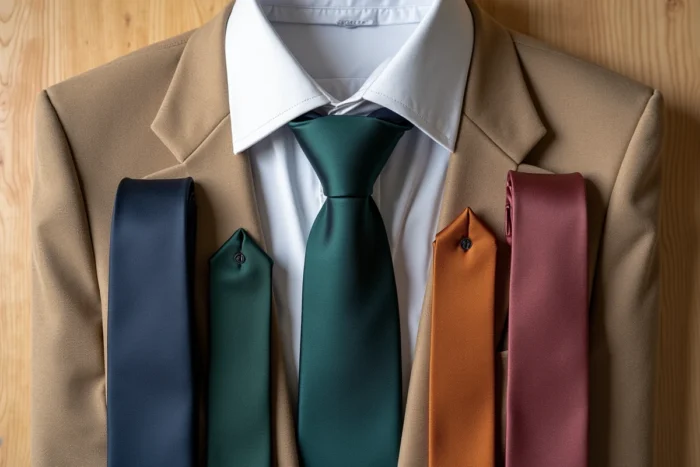
Comparison Table of Tie Colors by Context
| Tie Color | Contrast Level | Recommended Shirt | Suitable Context |
|---|---|---|---|
| Navy Blue | Strong | White or Sky Blue | Office, interview, formal ceremony |
| Burgundy | Medium-Strong | White or Ecru | Classic wedding, dressed event |
| Olive Green | Medium | Ecru, light beige | Country wedding, summer reception |
| Sage Green | Medium-Soft | White, natural linen | Bohemian wedding, garden party |
| Tobacco / Camel | Low (tonal) | White | Monochrome look, casual cocktail |
| Dark Brown | Medium | Ecru, light blue | Autumn, semi-formal meeting |
| Black | Very Strong | Only White | Rarely recommended (too sharp a break) |
The “contrast level” column is the primary sorting criterion. A navy tie on a beige suit remains the most versatile combination because it works from the office to a wedding without adjustment.
Olive Green or Sage Green Tie with a Beige Suit: The Gap That Changes the Outfit
The trend noted in wedding guides for the 2026-2027 seasons confirms a shift: the sand beige suit paired with a sage green or light tobacco tie is gradually replacing the beige-navy duo for summer weddings. Photographers and brides are seeking a soft harmony rather than a marked contrast.
Olive green and sage green do not produce the same effect. Olive green, more saturated and darker, provides an earthy anchor suitable for autumn outfits or country ceremonies in the late afternoon. Sage green, grayer and lighter, remains within a pastel palette that suits outdoor weddings and linen fabrics.
- Olive Green: prefer an ecru or light beige shirt to avoid a too-dull ensemble. A white linen pocket square breaks the monotony
- Sage Green: works with a white or natural linen shirt. Cognac leather or sand suede shoes complete the palette without overwhelming it
- Light Tobacco: a deliberate monochrome option, to be reserved for casual contexts where the beige suit is worn without a strict tie but with a bow tie or lavallière
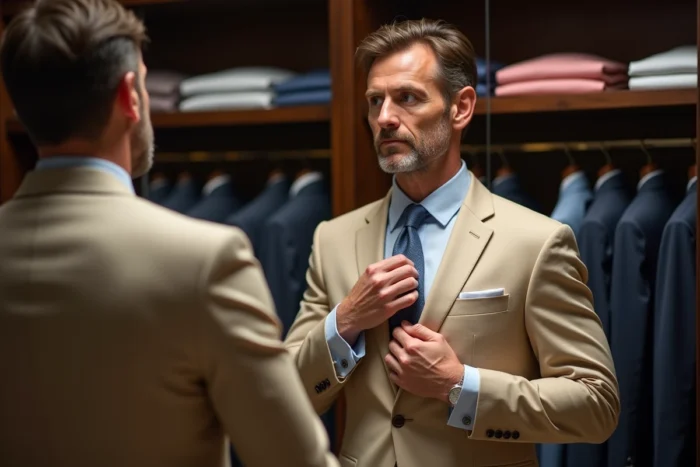
Burgundy or Navy Tie for a Beige Wedding Suit: Choose According to the Dress Code
For a classic or traditional wedding, protocol guides indicate that the groom, witnesses, and male relatives still wear ties during the ceremony, even with a light beige suit. The choice between burgundy and navy then depends on the dress code and the wedding color palette.
Burgundy adds a warm note that naturally dialogues with beige. It is a coherent choice when bridesmaids wear pink, terracotta, or marsala. In contrast, the navy tie stands out more and is better suited when the theme imposes cool or neutral tones.
For guests, the tie is no longer considered systematically mandatory in 2026-2027, especially for weddings with a bohemian, country, or casual dress code. A beige suit worn open-collared, without a tie, remains an acceptable option in these contexts.
Tie Material and Beige Suit: Silk, Cotton, or Linen
Color alone is not enough: the material of the tie alters the perception of the shade. A silk burgundy tie appears more saturated and formal than a cotton burgundy tie, which leans towards a matte and casual finish.
The beige suit, often worn in summer, pairs better with textured materials. A linen or cotton tie aligns with the summery nature of beige without creating a mismatch between a structured fabric and a soft suit.
- Silk: reserved for formal ceremonies and fine wool beige suits. The sheen of silk adds visual contrast even with a shade close to the suit
- Cotton: suitable for the office in summer and semi-formal events. The matte finish softens the contrast, favoring tonal combinations (brown, tobacco, camel ties)
- Linen: the most coherent choice with a linen beige suit. The slightly wrinkled texture gives a natural character to the outfit, especially outdoors
- Wool or knit: autumn option that works with dark or camel beige, particularly for olive green or burgundy ties
The last parameter to check remains the width. The width of the tie should match that of the suit lapel: a narrow lapel calls for a slim tie, a standard lapel (between seven and eight centimeters) a classic tie. On a beige suit, a width discrepancy between the lapel and tie is more noticeable than on a dark suit because the lightness of the fabric draws attention to the proportions.