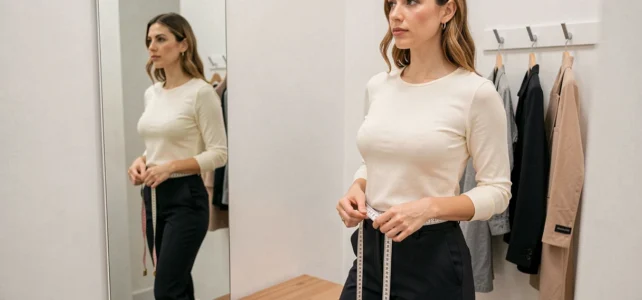
The size guide displayed on H&M’s customer service page is no longer sufficient. Recently, the brand has directed customers to a size guide specific to each product page, with measurements tailored to the cut, material, and specific model. Understanding this logic radically changes the reliability of an online order, especially knowing that H&M generally sizes larger than the European market average.
Size Guide by H&M Product Page: The Only Reliable Reference
The generic chart accessible from the customer service section provides a standard correspondence between alphabetical sizes (S, M, L) and body measurements. This chart remains useful as a starting point, but it does not account for variations in cut from one model to another.
The size guide linked to each product page is more precise than the generic page. H&M now recommends opening this guide directly on the desired item’s page. It includes specific measurements for the garment: chest circumference, waist circumference, hip circumference, inseam length for pants, and sometimes shoulder width.
The recommended process by H&M follows a clear logic: start with your usual size, open the guide on the product page, compare your own body measurements to the indicated values, and then adjust based on the textile composition. An item made from stretchy material is more forgiving than a rigid weave. We recommend always consulting the size guide at H&M before finalizing a cart, in addition to the product page itself.

Body Measurements and Garment Measurements: Technical Distinction at H&M
A common source of confusion arises from the difference between body measurements and finished garment measurements. H&M’s charts indicate body measurements, not the dimensions of the fabric laid flat. For a waist circumference stated at a certain value in the guide, the pants themselves incorporate a variable ease depending on the cut.
A slim fit adds very little ease. A regular fit adds more. A loose or wide-leg cut incorporates several additional centimeters. This is why two pairs of pants displaying the same EUR size on the site can feel completely different once worn.
How to Take Your Measurements for H&M
We observe that most sizing errors come from approximate measurement taking. Three measurement points are sufficient to cover nearly all categories:
- Chest circumference: measured horizontally at the fullest point, measuring tape passing under the armpits, without tightening
- Waist circumference: measured at the natural waist indentation, generally above the navel, while breathing normally
- Hip circumference: measured at the widest part of the hips, including the buttocks, feet together
For pants, the inseam length remains a neglected parameter. It is measured from the inside of the thigh (top of the groin) to the floor, barefoot. This data appears on some H&M product pages and helps anticipate a hem or a too-short fall.
H&M Sizes Large: Adjusting Your Selection by Category
The trend towards generous sizing at H&M is evident across most categories, but not uniformly. Feedback converges: baby and children’s clothing sizes are significantly larger than the age indicated on the label. Relying on centimeters rather than age ranges avoids unnecessary purchases.
For women, sizing varies depending on the type of piece. Basic jersey tops, often made from stretchy fibers, may appear roomier than expected. Stretch denim jeans exhibit the same discrepancy. However, some structured pieces (blazers, poplin shirts) follow a more fitted sizing.
Special Case of Stretch Materials
A garment containing a significant amount of elastane will stretch after a few hours of wear. On a stretch jean from H&M, sticking to your usual size rather than going down a size remains the safest choice if you prefer lasting support. The product page guide specifies the composition: this is where the decision is made.
For items made of knit or viscose, the relaxation is even more pronounced. A viscose top worn for an entire day gains in volume, especially around the shoulders and bust.
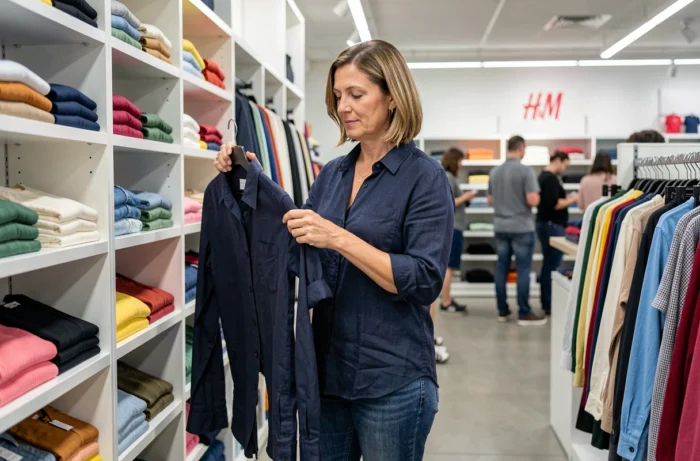
H&M Size Correspondence and European Equivalents
H&M sizes use the EUR system, but their correspondence with other brands is not automatic. An EUR 38 at H&M will not cover the same measurements as a 38 at Zara or Mango. Each fast fashion brand calibrates its patterns according to its own morphological database.
For men, the logic is the same. Shirts and t-shirts in S, M, L correspond to specific chest circumference ranges unique to H&M. We recommend never directly transposing a size from one brand to another without checking the centimeters.
| Reference | What to Check |
|---|---|
| Alphabetical size (S, M, L) | Correspondence in cm on the H&M product page |
| EUR size (36, 38, 40) | Associated body measurements, not just the label |
| Children’s size by age | Actual height centimeters of the child |
| Stretch material | Textile composition to anticipate relaxation |
When to Order Two Sizes
For pieces where the cut plays a decisive role (dress pants, fitted dresses, structured jackets), ordering two consecutive sizes and then returning the one that doesn’t fit remains the most effective method. H&M’s return conditions allow this approach without extra cost for members.
The sizing of clothing at H&M is based on a coherent system, provided it is read in the right place. The generic guide sets the framework, the product page refines it, and personal measurement taking makes the final decision. Three steps that take less than two minutes and avoid a back-and-forth with the return service.