
In the language of flowers, each variety carries a message. Some express love or friendship, while others convey much darker feelings. Betrayal, deception, and mistrust also have their plant ambassadors, often unknown to the general public. Identifying these flowers helps avoid a faux pas when composing a bouquet, but also allows for a deeper understanding of a whole aspect of European floral symbolism.
Dark Bordeaux Dahlia and Black Rose: Two Floral Faces of Betrayal
When searching for the flower that represents betrayal in the codes of floral language, the dark Bordeaux dahlia frequently comes up. Its deep hue, close to black, gives it a heavy symbolic weight: betrayal, dishonesty, and misfortune. It is not just the color that conveys this message, but the combination of the species and this very dark shade, which distinguishes this dahlia from its lighter cousins, associated with gratitude or elegance.
The black rose occupies a neighboring but more ambiguous territory. It can evoke tragic love, mourning, and in a more contemporary reading, a new beginning or personal transformation. The black rose is an ambivalent symbol, making it less reliable as a unique marker of betrayal. Giving a black rose without explicit context risks misunderstanding: the recipient may interpret it as the end of a relationship as a rebirth.
This distinction between the dark Bordeaux dahlia and the black rose illustrates a point often overlooked. The language of flowers is not a binary code. The same flower changes meaning depending on its color, cultural context, and declared intention.

Colchicum, Hemlock, and Carnation: Flowers Linked to Mistrust and Disgrace
The dark Bordeaux dahlia is not the only species associated with betrayal. Two plants frequently appear in lists of flowers to avoid: colchicum and hemlock. These plants evoke feelings of mistrust and deception in floral tradition. Their botanical toxicity has likely reinforced this symbolic association over the centuries.
The carnation deserves special attention. It is often perceived as a mundane flower, lacking in meaning. In reality, according to the codes of floral language, the carnation can express disgrace and betrayal, a message that few people suspect when seeing it in a florist’s bouquet.
Here are the main flowers and plants associated with betrayal or mistrust in the language of flowers:
- The dark Bordeaux dahlia (almost black): betrayal, dishonesty, misfortune. It is the flower most explicitly linked to this sentiment.
- Colchicum: mistrust, deception. Its toxicity reinforces this negative reading.
- Hemlock: the quintessential betrayal in ancient tradition, linked to the death of Socrates.
- Carnation (depending on the context): disgrace, betrayal. Its interpretation varies greatly depending on color and culture.
Symbolism of the Color Yellow and Infidelity: A Nuanced Amalgam
Yellow has long suffered from a bad reputation in Western symbolism. A color associated with deception, treachery, and infidelity, it has long tainted the perception of all yellow flowers, including the most joyful. The yellow rose can symbolize infidelity in a romantic context, with a real risk that the message is perceived as a request for a breakup.
This negative reading does not summarize the entire palette of yellow. Yellow flowers also carry messages of joy, friendship, and optimism. The sunflower, for example, evokes fidelity and admiration. The problem lies in the fact that the recipient of a bouquet does not always share the same symbolic reference as the sender.
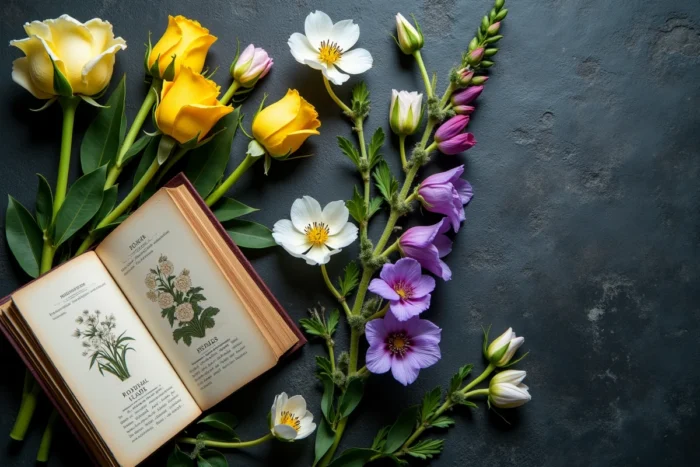
The meaning of a yellow flower thus depends on three factors:
- The specific species: a yellow rose and a sunflower do not carry the same message, despite their common color.
- The relational context: among friends, yellow remains a warm color. Among lovers, it can create discomfort.
- The culture of the recipient: codes vary from country to country. In France, mistrust of yellow is more pronounced than in other European traditions.
Chrysanthemum and Funeral Codes: Do Not Confuse Mourning with Betrayal
A common amalgam is to categorize the chrysanthemum among flowers of betrayal. In France, the chrysanthemum has been strongly associated with mourning since 1919, when it became the flower of All Saints’ Day. This link with death and the memory of the deceased has nothing to do with deception or dishonesty.
Giving chrysanthemums to a living person remains a major social faux pas in the French context. The chrysanthemum signifies mourning, not betrayal. Confusing these two symbolic registers is to mix two distinct grammars of floral language.
White carnations pose a similar problem. In the Mediterranean basin, they carry a traditional funerary use. Their presence in a birthday or congratulatory bouquet can cause discomfort unrelated to a message of betrayal.
Language of Flowers and Meaning: A System Without a Unique Standard
Dictionaries of the language of flowers are not standardized. Meanings vary according to sources, eras, and regions. The same dahlia can symbolize gratitude in a Victorian work and betrayal in a contemporary French guide. This lack of a universal reference makes any interpretation fragile if not accompanied by an explicit word.
For an unambiguous bouquet, the safest option remains to accompany the flowers with a written message. Floral symbolism enriches the gesture, but it does not replace it. The dark Bordeaux dahlia remains the flower most clearly and unanimously associated with betrayal in contemporary sources. The other species mentioned carry nuances that depend heavily on the context and the recipient’s interpretation.