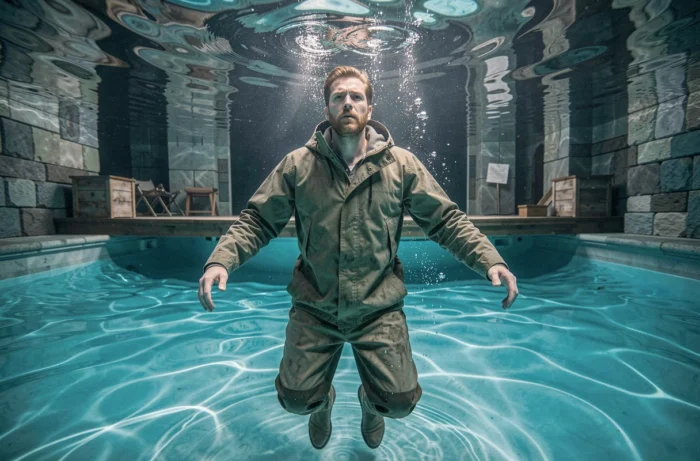
When a Viking disappears beneath the surface of the lake during the show at Puy du Fou, the audience holds its breath. The actor, however, does not hold his, or at least not as long as one might think. The management of breathing underwater in the park’s aquatic shows relies on a combination of concrete techniques, hidden equipment, and strict safety protocols, far from a simple magic trick.
Hidden Breathing Systems in the Aquatic Shows at Puy du Fou
On the ground, the main constraint is visual: the spectator must see nothing. Actors submerged in shows like Les Vikings or Le Secret de la Lance cannot wear a mask or a traditional diving regulator. All equipment must remain invisible from the stands.
The most common solution in this type of aquatic show involves hidden air supply systems beneath the surface. Compressed air pipes, fixed to the bottom of the pool or integrated into the submerged sets, allow actors to breathe from a mouthpiece positioned at a specific location. This is sometimes referred to as a “show hookah,” by analogy with the diving system that connects the diver to a surface air supply via a hose.
In practice, the actor swims to a predetermined point, grabs the mouthpiece, takes a few breaths, then releases it before continuing his choreography. The audience, located several dozen meters away, does not distinguish this quick gesture under water often made opaque by lighting or mist effects. The question of the actors’ breathing underwater at Puy du Fou fascinates visitors each season, but the answer is more about engineering than mystery.

Controlled Apnea and Physical Training of Actors
The hidden air supply does not cover all phases of the show. Between two breathing points, actors perform in apnea during short but meticulously choreographed sequences. Each underwater movement is rehearsed dozens of times before the season to ensure perfect timing.
Physical preparation includes specific work on lung capacity and breath management. Techniques similar to those used in cinema for underwater scenes are employed: diaphragmatic breathing exercises, progressive training in static apnea, and then dynamic apnea in motion.
What Preparation Changes on the Ground
A trained actor does not need to stay submerged for very long. The underwater sequences are divided into segments of a few seconds to a few tens of seconds, rarely more. The show creates the illusion of prolonged immersion through stagecraft: pyrotechnic effects, lighting plays, and crowd movements divert attention while the actor catches his breath at the surface or at an air point.
Feedback varies on the exact duration of the apneas depending on the shows, but the logic remains the same: minimize the actual time spent without air and enhance the visual effect perceived from the stands.
Safety Protocols for Aquatic Shows
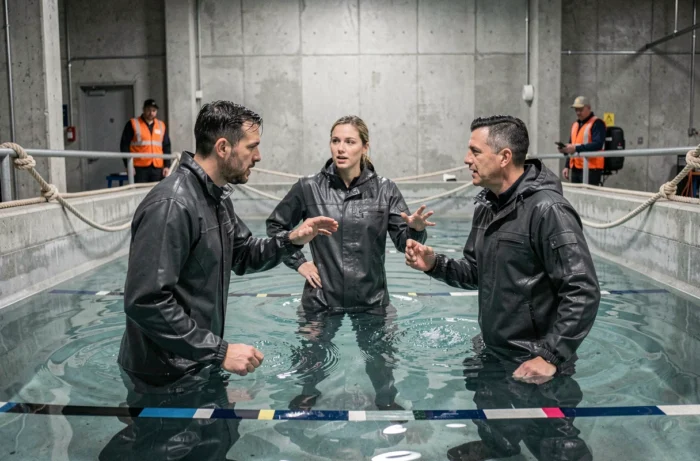
One does not place an actor in a pool like one sends an extra on stage. The aquatic shows at Puy du Fou align with the safety standards of underwater film shoots, with specific requirements:
- Safety divers positioned underwater or at the pool’s edge, equipped with tanks and ready to intervene within seconds in case of discomfort, blackout, or equipment failure.
- Continuous visual monitoring protocol: each submerged actor is followed by at least one dedicated operator who times the apnea phases and checks the return to breathing points.
- Rescue equipment immediately accessible, including surface oxygen and first aid supplies suitable for immersion accidents.
This setup is never visible to the public. Safety divers wear dark suits and remain in the shadowy areas of the pool, behind the set structures. Their presence is, however, the sine qua non condition for the show to take place.
Submerged Sets and Scenography Serving the Illusion
The breathing technique only works if the scenography supports it. At Puy du Fou, the pools of the aquatic shows are not just simple bodies of water. They are designed as true underwater filming sets.
The submerged sets serve a dual purpose. First, they provide reference points for the actors: a sunken drakkar bow, an artificial rock, or a metal structure allows the artist to position himself exactly where the air supply is located. Second, they conceal technical equipment from the audience’s view.
The Water Itself as a Scenic Tool
The color and turbidity of the water are controlled. Slightly murky water, combined with low-angle lighting, renders invisible everything happening more than a few centimeters below the surface. The geysers, jets of water, and pyrotechnic explosions that punctuate the shows are not only spectacular: they create visual curtains behind which actors can surface, breathe, and dive again without being noticed.
This coordination between special effects and breath management requires precise timing. Each activation of a water jet or flame corresponds to a breathing window for the actor below. The show is as much a technical score as it is an artistic performance.
Behind the Scenes of Puy du Fou Shows: Between Show and Technical Rigor
Puy du Fou deliberately maintains the mystery around its behind-the-scenes operations. In 2026, as the season opening approached, the park released a teaser video mentioning a supposed “Controlled Liquid Breathing,” humorously presented as an innovation allowing actors to breathe directly from hyper-oxygenated water. This communication was an April Fool’s joke, playing on the public’s fascination with the park’s secrets.
Behind the joke, the technical reality remains impressive. The combination of hidden air mouthpieces, trained short apneas, safety divers, and scenography designed to conceal each air intake constitutes a know-how that the park has refined over the seasons. Each aquatic show mobilizes a dedicated technical team, often from the world of professional diving or cinema.
The result, seen from the stands, can be summed up in one sentence: Vikings who seem to live underwater. The mechanics that make this possible is not magical but rather a precision craft.