
The thickness of a pair of glasses depends on three measurable parameters: the corrective power in diopters, the refractive index of the material, and the useful diameter of the lens once cut for the frame. Calculating this thickness before ordering lenses allows for anticipating the aesthetic result and the final weight of the equipment. Two approaches coexist to obtain this estimate: online calculators, accessible to everyone, and manual calculations, historically reserved for opticians trained in geometric optics.
Lens Thickness Formulas: What Manual Calculation Really Involves
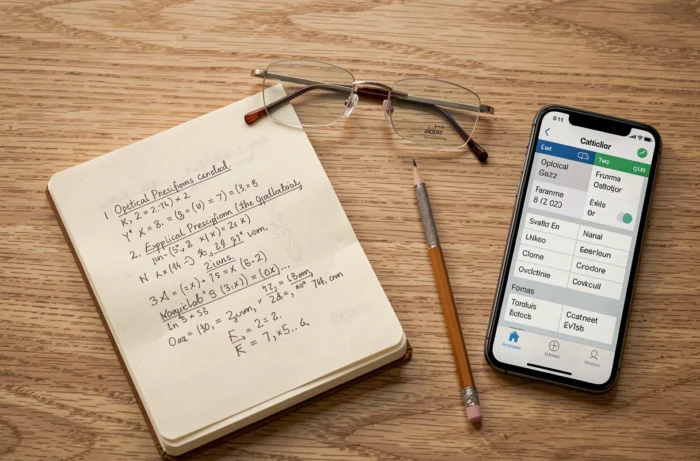
The manual calculation of the thickness of a corrective lens is based on formulas from the geometry of spherical and toric surfaces. For a simple spherical lens, the thickness at the edge (myopia) or at the center (hyperopia) is derived from the curvature of each face, the radius of the raw lens, and the refractive index of the chosen material.
In practice, this approach requires knowing the sag of each surface, which is the height of the spherical cap cut by the effective diameter. The classic formula relates the sag to the radius of curvature and the half-diameter of the lens. For a toric lens (astigmatism correction), this calculation must be repeated on two perpendicular meridians, which multiplies the steps.
An optician in a surfacing workshop masters these formulas because they are part of their training. For a glasses wearer without a background in geometric optics, reproducing this calculation without error requires understanding the relationship between power in diopters, radius of curvature, and index. A simple sign inversion or confusion between radius and diameter can skew the result by several tenths of a millimeter, which is enough to render the estimate useless.
To compare the available approaches, Pharmidea’s online tools detail the cases where each method finds its relevance, depending on the user’s technical level and the complexity of the correction.

Online Thickness Calculator: Input Parameters and Estimation Limits
Online simulators generally ask for the spherical power, any cylinder, the desired refractive index, and sometimes the diameter of the frame. Based on this data, an algorithm applies the same geometric formulas as a manual calculation, but automates the intermediate steps. The result is displayed in a few seconds.
The estimate remains theoretical: it assumes a lens of standard diameter (often 65 mm before edging) and does not take into account the actual decentration related to the wearer’s pupillary distance. However, this decentration alters the area of the raw lens that will be preserved after cutting, and thus the final thickness perceived on the frame.
What the Calculator Does Not Capture
- The decentration of the optical center relative to the geometric center of the lens, which depends on the pupillary distance and the width of the frame’s circle. In cases of high myopia, a decentration of a few millimeters significantly alters the thickness at the thickest edge.
- The shape of the frame: a round lens and a rectangular lens cut from the same raw blank do not retain the same peripheral areas. The maximum visible thickness changes according to the contour geometry.
- Surface treatments (anti-reflective, hardening) add a negligible thickness in absolute terms, but the tool also does not model the edge effect related to beveling or grooving for drilled frames.
These simulators serve a pedagogical role: they allow users to visualize the difference between an index of 1.50 and an index of 1.74, or to see that a moderate correction does not always justify an extra cost for an ultra-thin lens. This quick comparison function is their main asset for the general public.
Refractive Index and Lens Choice: When the Calculation Method Changes the Decision
The choice between manual calculation and online calculator does not carry the same stakes depending on the wearer’s correction. For mild myopia (around -2.00 diopters), the thickness difference between indices remains small, and the estimate from a simulator is sufficient to confirm that a standard index will suffice.
The situation complicates with medium to high corrections. A lens of -6.00 diopters in index 1.50 will be significantly thicker at the edge than in index 1.67 or 1.74. The difference becomes visually marked and the weight increases. In this case, the simulator provides a useful trend, but only a calculation that incorporates the actual decentration and the exact dimensions of the chosen frame yields a reliable thickness.
Toric Correction and Progressive Lenses
For a lens combining sphere and cylinder, the thickness calculation varies according to the meridian. Online calculators often simplify this point by providing only a maximum value. An optician calculates the thickness on the two main meridians, which helps anticipate the visible asymmetry of the lens in the frame.
For progressive lenses, the internal geometry of the lens (progression corridor, near and far vision zones) makes any online estimation even more approximate. The design of the progressive lens, unique to each manufacturer, alters the distribution of thicknesses in a way that public simulators do not model.
Prescription Validity and Care Path: A Context Not to Be Overlooked
Since decree n°2023-751 of August 10, 2023, an optician can adapt a glasses prescription in the context of a renewal, with a validity of up to 5 years for adults aged 16 to 42. This provision increases the frequency of renewals carried out directly with the optician, without going back to the ophthalmologist.
In this context, the optician becomes the main technical contact for thickness calculation. They have the measurement tools (pupillometer, frame tracing) and manufacturer software that incorporates all parameters. Using an online simulator before this visit helps formulate precise questions about the index or type of lens, but does not replace on-site measurement.
Online calculators and manual calculations address two different situations. The simulator is suitable for initial orientation, particularly to compare the effect of the index on thickness before going to the store. The complete calculation, including decentration, frame shape, and lens design, remains the responsibility of the optician who will cut the lens. Confusing the two amounts to taking an estimate for a measurement, which sometimes leads to mismatched expectations when picking up glasses.