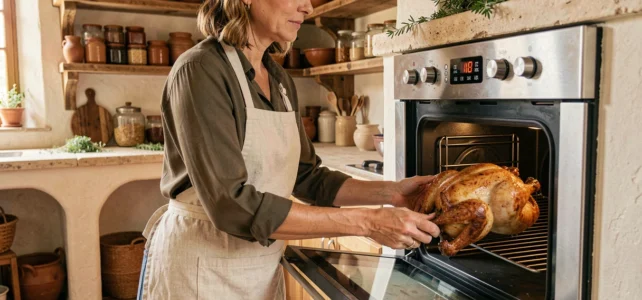
The thermostat 6 corresponds to 180 °C. This equivalence is based on a simple calculation rule: each thermostat level equals 30 °C. Multiplying the thermostat number by 30 gives the temperature in degrees Celsius. This reference works on most ovens, whether electric or gas, and serves as the basis for decoding any recipe.
Adjusting temperature for convection and static heat
Most recipes are written for an oven in static heat (also known as natural convection). Thermostat 6 corresponds well to 180 °C. However, a convection oven circulates hot air with the help of a fan, which speeds up the heat transfer to the food.
In practice, convection heat requires lowering the setting by about 20 °C compared to static heat. For a recipe that indicates 180 °C in conventional mode, setting the convection oven to around 160 °C allows for an equivalent result without drying out the preparation.
This difference explains why a cake baked in static heat may become too dry in convection heat if the temperature remains the same. Understanding the correspondence of 180 degrees in thermostat according to the cooking mode avoids this type of mishap.
The same reasoning applies to air fryers, which function like compact convection ovens. A recently published converter recommends adjusting from 180 °C to 160 °C when transferring a classic recipe to an air fryer.
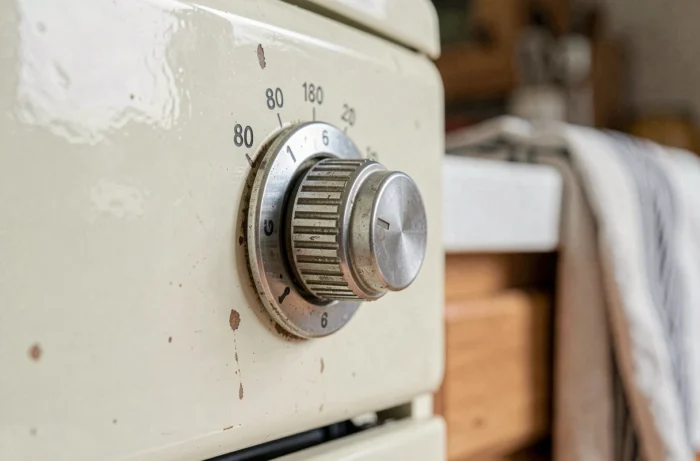
Oven preheating: why the actual temperature matters more than the thermostat
Turning the knob to thermostat 6 does not mean the oven instantly reaches 180 °C. Preheating is a crucial step, as placing a dish in a still-warm oven alters the cooking time and final texture.
Most modern ovens indicate the end of preheating with a light or a beep. On an older model without an indicator, counting about ten minutes after starting gives a reasonable estimate for an electric oven set to 180 °C.
Checking the reliability of your oven
An oven that displays 180 °C does not always heat exactly to that temperature. The discrepancy can be significant, especially in older appliances whose thermostats can drift over time.
An independent oven thermometer, placed in the center of the rack, remains the simplest way to check the actual temperature. This small accessory is inexpensive and useful for every cooking session.
- Place the thermometer in the center of the oven, at mid-height, away from the walls.
- Wait for the oven to complete its preheating cycle before reading the measurement.
- Compare the reading with the displayed setting: a difference greater than about fifteen degrees warrants an adjustment of the setting or a recalibration.
Cooking at 180 °C: which dishes and how to adjust the time
Thermostat 6, or 180 °C, corresponds to what recipes call a medium oven. This setting is suitable for a wide range of preparations: classic pastries (cakes, madeleines, tarts), gratins, moderately sized roasted poultry, or baked vegetables.
For baking, 180 °C offers a good compromise between a golden crust on the surface and even cooking throughout. Increasing the temperature would cook the outside too quickly while leaving the center raw, while lowering it would extend the time without improving texture.
Poultry and meat: the core probe as a true reference
Setting the oven to 180 °C alone does not guarantee perfect cooking of a piece of meat. The weight, shape, and initial temperature of the piece largely influence the result. Several recent guides emphasize using a core probe rather than relying solely on the timer.
The probe measures the internal temperature of the meat, the only reliable indicator to distinguish between perfectly cooked and undercooked. A chicken, for example, must reach a sufficient internal temperature before being considered cooked, regardless of the time spent in the oven.
- Insert the probe into the thickest part of the piece, avoiding contact with the bone.
- Let the meat rest for a few minutes after removing it from the oven: the internal temperature continues to rise slightly.
- Adjust the cooking time to the actual weight of the piece rather than a standard duration taken from a generic recipe.
Foreign recipes: beware of temperature scales
The reference of 180 °C does not have the same meaning everywhere. In the UK, a “dial 4” on some ovens corresponds to 180 °C, while the French scale follows the logic of thermostat multiplied by 30. Anglo-Saxon recipes often express temperature in degrees Fahrenheit, which can create direct confusion.
180 °C is equivalent to about 356 °F. Reading “350 °F” in an American recipe means setting your oven just below 180 °C. This discrepancy may seem minor, but on a sensitive pastry, a few degrees too many or too few can alter the result.
Before following a recipe found online in another language, checking the temperature unit helps avoid baking a brownie at 180 °F (just over 80 °C) instead of 180 °C.
Ultimately, oven cooking relies on three pillars: a reliable conversion between thermostat and degrees, a respected preheating, and a verification of the actual temperature inside the cavity as well as in the core of the food. An oven thermometer and a core probe cover almost all situations where simply adjusting the thermostat is not enough.