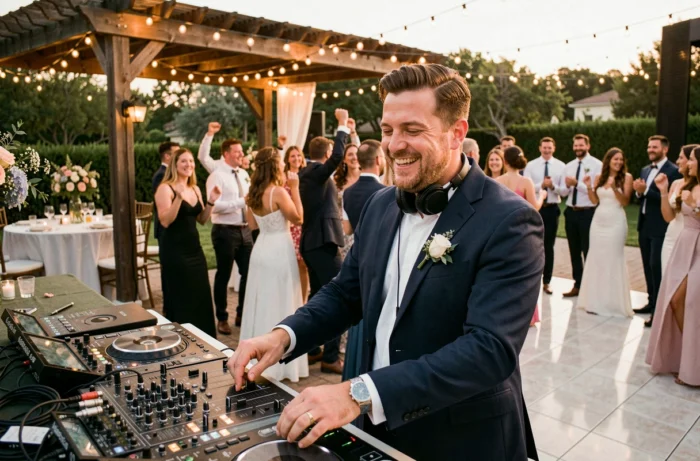
A wedding activity refers to any engagement offered to guests to enliven the reception, encourage interactions, and create shared memories. The choice of these activities shapes the atmosphere of the day, from the cocktail hour to the end of the evening. It is essential to distinguish between formats that genuinely include all guests and those that, despite their popularity, leave part of the assembly on the sidelines.
Cooperative activities: creating connections without leaving anyone behind
Most idea lists suggest competitive games (musical chairs, timed blind tests, team challenges). These formats work well with a young and homogeneous audience, but they pose a problem when the table mixes grandparents, children, colleagues, and close friends.
Cooperative activities take the opposite approach: the goal is not to win, but to create something together. A sound wall, for example, invites each guest to record a short voice message on a terminal. The couple leaves with an audio mosaic of their day. A collective mural workshop operates on the same principle: everyone paints a fragment of a canvas that the couple will keep.
The main interest is to facilitate exchanges between guests who do not know each other without forcing participation. Anyone can remain a spectator, contribute discreetly, or get more involved. This free engagement slider avoids the discomfort caused by games that call for volunteers on stage.
To delve deeper into this type of format, the animation on the La mariée de Sophie website details several formulas adaptable to the size of the reception and the style of the ceremony.
Accessibility and inclusivity of wedding games
Designing an accessible activity goes beyond providing a ramp. Sensory accessibility is just as important as physical mobility. A photobooth with a strobe flash can be problematic for people with epilepsy. A sound environment that is too loud excludes hearing-impaired guests or those sensitive to noise, as well as elderly individuals.
Three criteria help verify that an activity is suitable for all guest profiles:
- The game rule can be understood in one sentence, without lengthy explanations or reading instructions displayed in small print.
- Participation does not require prolonged standing, enforced physical contact, or alcohol consumption.
- A quiet space nearby offers an alternative for guests who wish to step away temporarily.
Recent recommendations also discourage games based on gender stereotypes, sexualization, or past relationships. A quiz about the couple that asks “who has had the most exes?” may seem funny on paper, but it often generates palpable discomfort in the room.
Spreading activities throughout the day rather than concentrating them in the evening
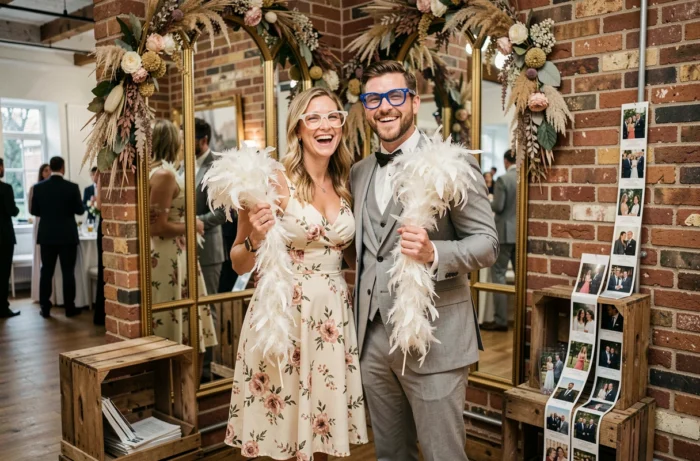
Intimate weddings favor activities spread over several times of the day. The cocktail hour, often lengthy, lends itself to short and self-contained formats: a flower bar where each guest composes a small bouquet, a self-service polaroid corner, or a guided tasting of local olive oils or honeys.
The meal calls for table formats: a memory book slipped between the utensils, a discreet quiz about the couple printed on the back of the menu. These micro-activities do not interrupt service and occupy waiting moments between courses.
The evening remains the time for more spectacular formats. A live performance (percussion, dance, fire juggling) marks an effective rhythm break before the opening of the dance. Limiting the program to three or four well-placed activities avoids the catalog effect that exhausts guests and hinders spontaneous conversations.
Event sobriety: low-impact wedding activities
The disposable photobooth with imported plastic props remains one of the most polluting aspects of a reception. The eco-responsible trend encourages couples to rethink these types of choices.
Some concrete ideas for event sobriety applied to activities include:
- Replacing disposable photobooth props with thrifted items or decorative elements already present at the venue.
- Favoring compostable or reusable materials for creative workshops (seeded paper for the guestbook, plant-based inks for the mural).
- Choosing local providers for live performances, which reduces travel and supports the local economy.
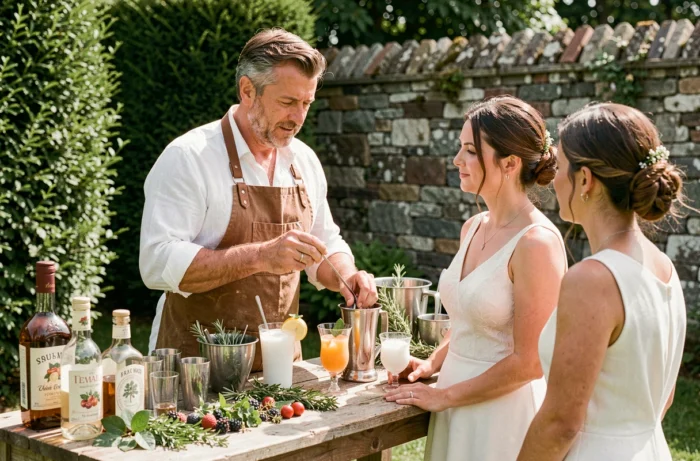
A non-alcoholic cocktail bar, prepared with artisanal syrups and fresh herbs, works just as well as a classic bar in terms of atmosphere. It includes pregnant women, children, and non-drinkers without creating a separate category.
What sobriety changes in memory
The most memorable activities are not the most expensive. A release of biodegradable lanterns, a talking circle where each loved one shares an anecdote in two minutes, a collaborative playlist built in advance by guests: these formats rely on sincere participation rather than staging.
The most reliable sorting criterion remains the following question: would this activity make as much sense at another wedding, with different people? If the answer is yes, it probably lacks personalization. The best memories arise from a detail unique to the couple, not from a standardized format reproduced identically from one reception to another.