
The flourishing of a child relies on a set of concrete conditions: emotional security, the opportunity to explore at their own pace, and the attentive presence of an adult. Supporting the well-being of children on a daily basis is not about applying a single method, but about adjusting responses to the real needs of each age and temperament.
Parental technoférence and availability: a often overlooked lever
Articles on children’s well-being almost always focus on the child’s screen time. A less addressed angle concerns the digital availability of the parents themselves. A study conducted by Bayard Jeunesse and the Observatoire Santé PRO BTP reports that a significant proportion of parents of children under 5 years old have their interactions interrupted by a screen.
This phenomenon has a name: technoférence. It refers to the repeated interruptions of parent-child interaction caused by a connected device. A child seeking their parent’s gaze and encountering a face absorbed by a phone receives an ambiguous signal about their own value.
Reducing these micro-disruptions in daily life involves simple gestures: placing the phone out of visual reach during meals, disabling non-urgent notifications between school pick-up and bedtime. Specialized resources like nosenfantsdabord.com allow for a deeper exploration of these issues related to attentive parenting.
The flourishing of a child depends as much on what the adult offers as on what the adult is willing to put on pause for them.
Screens and children: adapting rules to context rather than the clock
The High Council for Public Health recommends avoiding screens in the bedroom and during the hour before bedtime. This recent French approach prioritizes the context of use rather than a universal time threshold. The type of content, the time of day, and the presence or absence of an adult matter more than a count in minutes.
The results of the national Enabee study show that screen time is significantly higher on non-school days for preschool and primary school children. Treating school days, weekends, and holidays separately provides more realistic benchmarks than applying the same rule every day.
Integrated parental control from 2024
Since July 13, 2024, connected devices sold in France must include a free parental control feature and offer its activation during the initial setup. This regulatory measure simplifies the process for parents but does not replace discussions with the child about what they are watching and why.
A child who understands the reason for a limit internalizes it better than a child who passively endures it. Explaining that screen time before bed delays falling asleep gives concrete meaning to the rule.
Child autonomy: progression in stages according to age
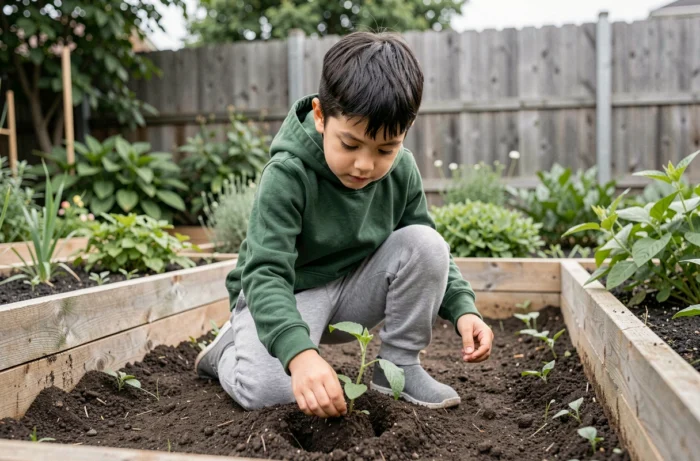
Autonomy cannot be taught all at once. It is built through successive stages adapted to the motor and cognitive skills of each age group. Assigning a task that is too complex generates frustration, while a task that is too simple provides no learning.
- Between 2 and 4 years old, a child can put their toys away in a bin identified by color, choose between two outfits offered, or pour water from a small pitcher.
- Between 5 and 7 years old, preparing a simple snack, tying their shoes, or organizing their backpack the night before are suitable stages.
- From 8 years old, managing a small budget for an outing, planning homework for the week, or preparing a meal develops decision-making skills.
Each success, even partial, boosts self-esteem. Valuing effort rather than results encourages the child to try again after a failure without perceiving mistakes as a threat.
Welcoming emotions: the role of verbalization in the child’s well-being
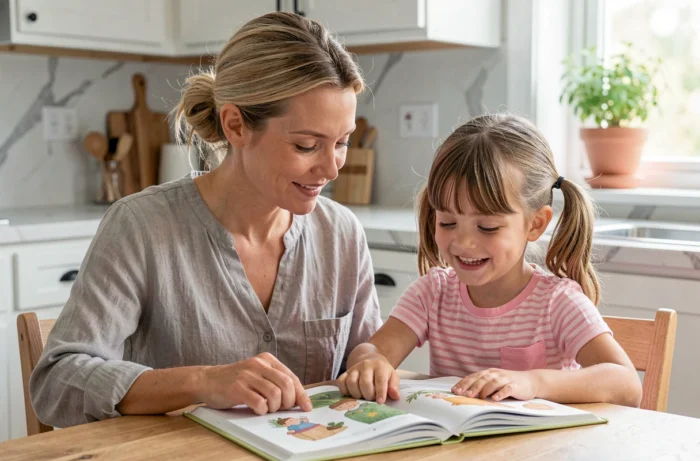
A child who cries out of anger or frustration does not need their feelings to be minimized. Verbalization involves naming the emotion for the child: “You are angry because your brother took your toy.” This simple verbal reflection gives them a tool to understand what is happening inside them.
Neuroscience shows that naming an emotion reduces the activation of the amygdala, the brain area involved in stress reactions. The child gradually learns to identify and then regulate their emotional states, a skill that will serve them well beyond childhood.
Differentiating emotion and behavior
Accepting the emotion does not mean accepting all behavior. A child has the right to be furious. They do not have the right to hit. This distinction, calmly and repeatedly stated, builds a framework where the child feels allowed to feel without fearing judgment, while learning social boundaries.
Parents who also appropriately verbalize their own emotions (“I am tired, I need some quiet”) provide a concrete model. The child learns by imitation before learning through instruction.
Physical activity and free play: underestimated needs in daily life
Free play, without instructions or goals imposed by adults, develops creativity, problem-solving, and social skills. A bored child eventually invents, and this capacity for initiative only develops if they are given unstructured time.
Regular physical activity, whether it’s a trip to the park, a walk to school, or club sports, directly impacts sleep quality and emotional regulation. On days when the child moves enough, evenings generally go better.
Offering concrete alternatives to screens on non-school days (crafting, cooking, nature outings) works better than a flat prohibition. The child needs an attractive option, not just a refusal.
Ultimately, supporting a child’s flourishing relies on a few stable axes: being present without a phone in hand, adapting rules to the real context, allowing autonomy to progress in stages, and naming what the child feels before correcting what they do. These daily gestures, repeated without perfection, build a foundation of security on which each child can grow at their own pace.