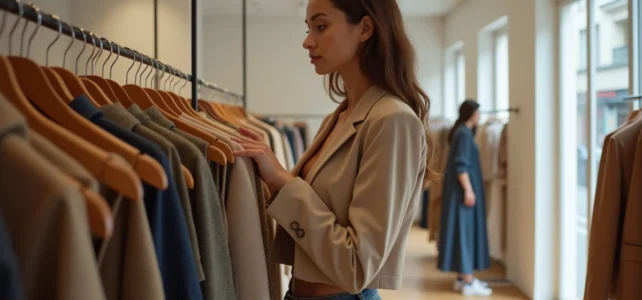
The outfits worn in Demain nous appartient generate a demand that neither the production nor the brands have structured for the general public. No official catalog, no visible label on screen, no displayed fashion partnership: the viewer who wants to recreate a look seen in an episode must assemble the pieces of the puzzle themselves.
Between the Vinted account managed by TF1, the official shop limited to merchandise, and fan communities on social media, there are options, but none cover the entire wardrobe of the series.
Visual search and piece identification: the method that works
The main difficulty is not finding a seller, but identifying the exact piece. The costume designers of DNA draw from mainstream brands (Zara, Mango, Sandro, Ba&sh) as well as capsule collections or vintage pieces. No end credits credit the clothing worn by the characters.
Image search remains the most reliable lever. Google Lens, integrated into the Google Photos app, allows you to capture a paused scene and initiate a visual search. The result often leads to active or archived product sheets, providing at least the brand and reference.
To find out where to buy the clothes from Demain nous appartient, this prior identification step changes everything: without a precise reference, searching on Vinted or in an online shop is like looking for a needle in a haystack.
Facebook groups dedicated to the series complement this work. Fans post screenshots after each episode and collectively identify the brands. The responsiveness there is sometimes faster than a search engine because some members recognize the pieces they already own.

TF1 Vinted account and sale of shooting outfits
TF1 has set up a shared Vinted account for the series Demain nous appartient and Ici tout commence. The pieces actually worn on screen are put up for sale occasionally, and the profits are donated to La Cravate Solidaire, an organization that supports people in professional reintegration.
This channel remains the only way to acquire a garment authentically worn by an actor during filming. However, the listings are irregular and the stock is limited to one piece per reference. A dress worn by a character in an episode often sells out within hours.
- The listings do not always specify the character or the episode in question, making tracking difficult without active monitoring.
- The sizes correspond to those of the actors, not to a typical commercial range.
- The prices remain moderate (second-hand logic), but the rarity drives some buyers to check the account daily.
Confusing this Vinted account with the official shop of the series is a common mistake. The site demainnousappartient.com sells merchandise (keychains, magnets, Spoon-themed accessories), not the clothes seen in the episodes.
Sold-out collections and hard-to-find pieces: the limits of the market
Some of the outfits worn in DNA come from seasonal collections that have already been withdrawn from sale. Fast fashion brands refresh their ranges every few weeks. Between the filming date and the airing of the episode, several months can pass, which is enough to render a piece unavailable in stores.
In this case, three options are available:
- Search for the exact reference on second-hand platforms (Vinted, Vestiaire Collective, Leboncoin) by filtering by brand, size, and color.
- Identify a similar piece from the same brand or a competitor, relying on the cut and color identified via Google Lens.
- Follow the Instagram accounts of specialized fans who post accessible alternatives, sometimes on the same day as the airing.
Some pieces seen on screen are never marketed, because they belong to a costume designer’s personal stock or come from loans from designers without distribution agreements. On this point, the available data does not allow for estimating the exact proportion of affected outfits.
Episode tracking: organizing your DNA fashion watch
The most effective approach is to systematize the process rather than reacting on a case-by-case basis. Watching the episode on replay (on TF1+ or MyTF1) allows you to pause, capture the image, and initiate the visual search right away.
Some habits speed up the process. Capturing the widest possible shot of the garment improves the accuracy of Google Lens. A close-up of a pattern or detail also works, provided the fabric is well lit. Scenes filmed outdoors in Sète generally offer more usable light than the interiors of the Spoon.
Complementary tools for identifying DNA clothing
Pinterest offers a visual search function comparable to Google Lens, with the advantage of linking to pins related to product sheets. The lesser-known app ShopLook aggregates looks reconstructed by users and can surface pieces from French series.
Field feedback varies on the reliability of these tools when the garment is a basic piece (white t-shirt, raw jeans). The more distinctive the piece, the more effective the visual search results.
The most cost-effective reflex remains to cross the visual search with a targeted text query: the character’s name, the description of the garment, and the word “DNA” are often enough to land on a fan post that has already done the identification work.