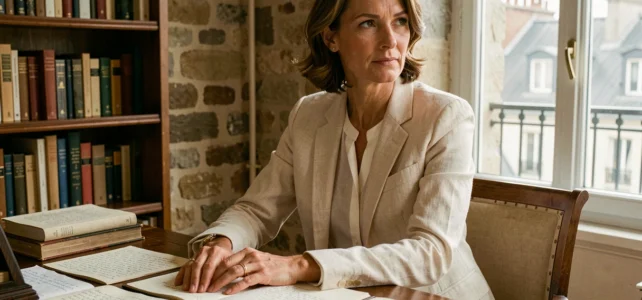
Juliette Plumecocq-Mech, born on January 1, 1968, in Soissons, is one of those French actresses whose stage career commands respect long before cinema or television take notice. Trained at the Conservatoire à rayonnement régional de Bordeaux, she joined the Théâtre du Soleil troupe of Ariane Mnouchkine, an experience that has lasting effects on her acting method and her relationship with the collective.
Androgynous physique and acting style: an atypical career lever
Juliette Plumecocq-Mech’s androgynous appearance is not just an anecdotal trait. It is a factor that has shaped her role choices for three decades. She recently revealed that being mistaken for a man had long been a personal wound before becoming a fully embraced element of her artistic identity.
Christophe Rauck, whom she met at the Théâtre du Soleil, exploits this uniqueness by casting her in male roles: Lancelot in Le Dragon, Khlestakov in Le Révizor, Aristarque in Cœur ardent. In 2016, he directed her lying down, portraying a man assaulted in a café, in Toute ma vie, j’ai fait des choses que je savais pas faire by Rémi De Vos.
This ability to inhabit male roles without caricatural cross-dressing distinguishes Juliette Plumecocq-Mech in the French theatrical landscape. Here we see a case where physical uniqueness, far from closing doors, has broadened the spectrum of accessible roles. To delve deeper into the biography and private life of Juliette Plumecocq-Mech, other sources provide useful insights to complete this portrait.
Juliette Plumecocq-Mech as an actress in crime series: a recent professional positioning

Recent content repositions Juliette Plumecocq-Mech in a very specific register: that of institutional roles in French crime series. Commander, prosecutor, doctor, commissioner. It is no longer the experimental theater actress who dominates her screen presence, but a recurring authority figure in television fiction.
Season 2 of the series À l’instinct illustrates this trajectory. Juliette Plumecocq-Mech plays Oriane Girard, a role initially broadcast on the France.tv platform before moving to France 2. This “platform first” distribution model changes the visibility of actresses in this register: the initial audience is younger, more connected, and the role benefits from a digital discovery window before linear broadcasting.
Her notable screen appearances include productions with varied tones:
- Le Tueur du lac, a crime series where she plays a central role in the plot
- Antoinette dans les Cévennes, a dramatic comedy by Caroline Vignal, which offers her mainstream cinematic exposure
- Coup de chance by Woody Allen, a shoot that places her in an international production context
- The series Vortex and the program Surface, which confirm her regular presence in contemporary French fiction
The shift from theater to crime series is not a casting coincidence. It reflects a clear career strategy: to capitalize on a unique physical presence and an authoritative acting style forged on theater stages to occupy roles that French television rarely assigns to unconventional profiles.
Juliette Plumecocq-Mech’s private life: why the absence of information is the real fact
Juliette Plumecocq-Mech does not communicate about her romantic or family life. No partner or child has been publicly confirmed. This observation, repeated by several recent sources, constitutes the most solid verifiable information on this subject.
We note that this discretion contrasts with the usual media behavior of actresses from her generation. The tabloid press operates on an implicit exchange: media visibility for fragments of private life. Juliette Plumecocq-Mech has refused this contract since the beginning of her public career.

This stance has a measurable professional cost. Fewer magazine covers, fewer appearances on entertainment shows, less “buzz” around projects. In return, her credibility in authority roles remains intact, untainted by a public image that could interfere with the perception of her characters.
Théâtre du Soleil and Compagnie Terrain Vague: the theatrical foundations
Her time at the Théâtre du Soleil of Ariane Mnouchkine remains the technical foundation of Juliette Plumecocq-Mech. It is in this troupe that she meets Christophe Rauck, who founded the Compagnie Terrain Vague (provisional title) with her and other actors from the same collective in 1995.
The list of directors she has collaborated with outlines a coherent network:
- Julie Brochen, for Whistling Psyche by Sebastian Barry
- Christian Schiaretti, for Perceval le Gallois by Florence Delay
- Olivier Martin-Salvan, for Ubu sur la butte by Alfred Jarry
This network of theatrical collaborations explains the longevity of her stage career. The directors who seek her out share a common taste for demanding text-based theater, often at the intersection of classical repertoire and contemporary writing. In 1993, she received the Prix de la Critique (AQCT), an early recognition that validates her trajectory even before her transition to screen.
Juliette Plumecocq-Mech’s journey remains that of an actress whose career has been built on stage, not through television casting. Her personal discretion, far from being an accident, extends an artistic logic where the role takes precedence over the person. Recent crime series offer her new visibility, but it is theater that continues to shape her approach to the profession.