
A seller accepts your offer on Leboncoin, sends you a bank account details via private message, and asks for a transfer “to speed things up.” Two days later, the ad has disappeared, the seller is no longer responding, and your bank explains that a standard transfer does not offer any automatic recall procedure. This scenario affects an increasing number of users on the platform every year, both buyers and sellers.
IBAN verification before transfer: what your bank is doing since October 2025
Since October 9, 2025, banks in the euro area compare the name of the beneficiary you enter with the actual holder of the IBAN. If they do not match, a clear alert appears before the transfer is validated. This measure directly targets scams where the fraudster provides bank account details in the name of a third party or a shell entity.
In practice, when selling a sofa to an individual who introduces themselves as “Martin Dupont” and the IBAN points to a company registered abroad, the bank signals the discrepancy. The problem is that the alert remains advisory. Nothing prevents the hurried user from validating the transfer anyway.
On Leboncoin, the basic rule is simple: if your bank displays a discrepancy message, do not validate the transfer and cut off contact. A legitimate seller has no reason to provide an IBAN that does not match their declared identity. Several reports on specialized forums confirm that securing the bank transfer on Leboncoin primarily relies on this consistency check between the name and the IBAN.
Instant transfer on Leboncoin: why recourse is nearly impossible
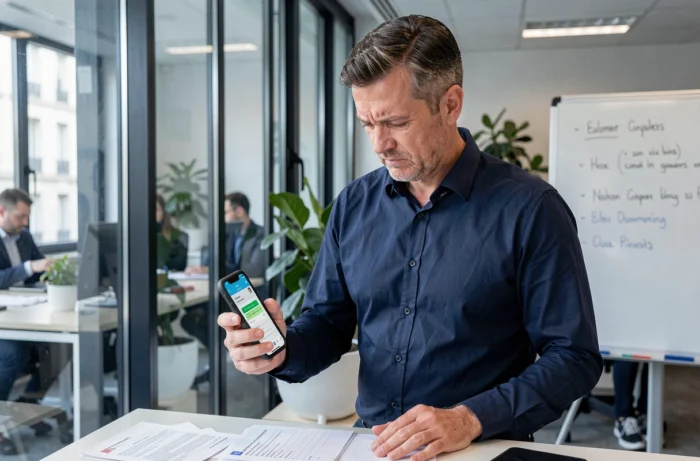
Fraudsters increasingly request an instant transfer rather than a standard transfer. The reason is technical: an instant transfer is credited to the beneficiary’s account in a few seconds. The time to attempt a recall of funds is counted in minutes, not days.
With a standard SEPA transfer, there is theoretically a short period before full execution, during which the bank can still intervene. This period completely disappears with instant transfers. Once the money is gone, the recipient’s bank has no obligation to cooperate for a return of funds.
Always prefer the standard SEPA transfer if you cannot use Leboncoin’s integrated payment system. And even in that case, keep in mind that the transfer remains a payment method without a safety net: no buyer protection, no dispute mechanism comparable to what a credit card or the platform’s secure payment offers.
When the transfer is justified nonetheless
For a vehicle or a high-value item, a bank transfer may sometimes be the only method accepted by the seller. In this specific case, the risk can be limited by making the transfer on-site, after inspecting the item, and requiring a copy of the seller’s ID to verify the match with the provided bank account details.
Fake confirmation emails and phishing via Leboncoin messaging
The scam does not always go through the transfer itself. A common method involves sending a fake email mimicking Leboncoin’s secure messaging, with a link that redirects to a clone site. The buyer or seller enters their banking details there, thinking they are using the platform’s secure payment service.
Several elements can help identify these attempts:
- The email’s sending address does not come from the official leboncoin.fr domain, but from a close variant (leboncoin-paiement.com, service-lbc.fr, etc.)
- The message contains unusual spelling or grammatical errors for an automated communication from a large platform
- The link in the email points to a URL that does not start with https://www.leboncoin.fr, which can be checked by hovering over the link without clicking
- The amount mentioned in the email does not exactly match the price agreed upon in the conversation on Leboncoin
Never click on a link received by email to finalize a payment. Always return to the Leboncoin app or website by your own means to check the status of the transaction.
Secure payment on Leboncoin: what it covers and its limits

Leboncoin’s integrated payment system holds the funds until confirmation of receipt by the buyer. For remote transactions, it is the only mechanism that offers protection comparable to that of a traditional marketplace. The seller receives their money only after validation, and the buyer can report a problem to trigger mediation.
However, this system has blind spots. Reports vary on this point, but several users report long processing times in case of disputes, and difficulty reaching customer service for complex cases. For vehicle purchases, Leboncoin’s secure payment is not always offered, pushing buyers and sellers towards bank transfers or cashier’s checks.
Here are the reflexes to adopt for each transaction on the platform:
- Use Leboncoin’s secure payment whenever it is available, even if the seller offers “a transfer to simplify”
- Check the consistency between the seller’s name on the ad and the holder of the IBAN if a transfer is necessary
- Never continue a conversation outside of Leboncoin messaging (SMS, WhatsApp, direct email), as this cancels any traceability in case of a dispute
- Refuse any payment by cash mandate, recharge coupon, or transfer to a foreign account
Staying within the messaging and payment circuit of the platform is the best protection available. As soon as someone urges you to leave this environment, the risk of scam increases significantly. A good faith seller or buyer has no reason to bypass the tools provided by Leboncoin.