
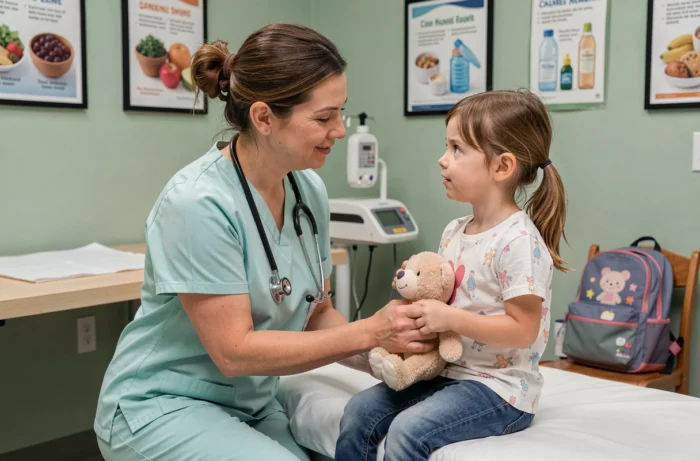
The systematic psychological assessment at age 6, announced as a flagship measure of the School Health Conference, redefines the framework for early detection in children’s mental health. This initiative is accompanied by a fast-track system to access mental health centers for students identified as experiencing psychological distress, a direct response to waiting times that could reach several months in some departments.
The government has also deployed 100 mental health reference psychologists, one per department, within dedicated health, well-being, and child protection hubs.
Psychological assessment at age 6: a standardized detection integrated into the school journey
Detection no longer relies solely on parental or teacher reporting. A standardized protocol is now included in the school journey, targeting a developmental window where anxiety disorders, attention difficulties, and learning delays become sufficiently apparent to trigger a referral.
The fast-track system provides the initiative with its concrete impact. Without an acceleration in care, the assessment would remain a formality without follow-up. Departmental reference psychologists ensure coordination between the National Education, medical-social structures, and families.
Professionals following the news on Parlons Enfance will find details on the deployment modalities of this assessment, territory by territory.
Homeless children in France: the figures from the 2026 barometer
The “Children on the Streets” 2026 barometer, published by UNICEF France and the Federation of Solidarity Actors, documents a continuous deterioration. On the eve of the 2026 school year, at least 2,355 children remained without a solution after calling 115, including 514 under the age of 3.
The increase reaches 9% compared to 2025 and 42% since 2022. These figures only account for calls to 115 that were actually made: the real phenomenon is likely underestimated.
Impact on the development and health of homeless children
Without stable housing, schooling becomes fragmented, medical follow-up is interrupted, and continuity of care disappears. A child under 3 years old without stable housing misses regular PMI follow-up and health assessments scheduled in the first 1,000 days journey.
We recommend reading these figures in light of the repeated public commitments to prevent severe child poverty. The gap between announcements and measured results widens each year.
Environmental health in the first 1,000 days: a public health priority in 2026
Perinatal environmental health is becoming a priority in institutional agendas. The first 1,000 days concentrate a particular vulnerability to endocrine disruptors, air pollutants, and food contaminants.
The actions undertaken focus on training perinatal professionals to identify environmental exposures and on structuring dedicated consultations. The goal goes beyond parental information: it aims to integrate the environmental dimension into obstetric and pediatric follow-up protocols.
- Training midwives and childcare workers on the risks associated with endocrine disruptors during pregnancy and early childhood
- Integration of recommendations on indoor air quality in early childhood care settings

Mental health of adolescent girls: a gendered dropout to be considered
Recent data confirms a marked dropout among adolescent girls. Emergency admissions for self-harming behaviors and anxiety-depressive disorders disproportionately affect girls aged 10 to 19.
This gendered dropout calls for differentiated prevention measures. Universal prevention programs in school settings, designed without gender distinction, overlook specific risk factors: body image pressure amplified by social media, cyberbullying with a sexist component, and early mental load in certain family contexts.
Access to care in child psychiatry: a structural bottleneck
The shortage of child psychiatrists remains the main barrier. The 100 reference psychologists deployed by department constitute an initial network but do not compensate for the deficit of specialist doctors. Psycho-educational centers have waiting lists of several months in the majority of territories.
Protection in daycare and regulatory framework
The strengthened reporting obligation for establishment managers, in case of concerning behavior from a team member, reflects a desire to structure the protection of children welcomed in collective settings.
- Strengthening procedures for checking criminal backgrounds for professionals working with children
- Strengthened reporting obligation for establishment managers in case of concerning behavior from a team member
- Integration of modules on preventing ordinary educational violence in the ongoing training of childcare assistants
The articulation between these regulatory provisions and the reality on the ground remains a major point of vigilance. A normative framework only produces effects if accompanied by sufficient control and training resources, both of which are currently under pressure in the early childhood sector.