
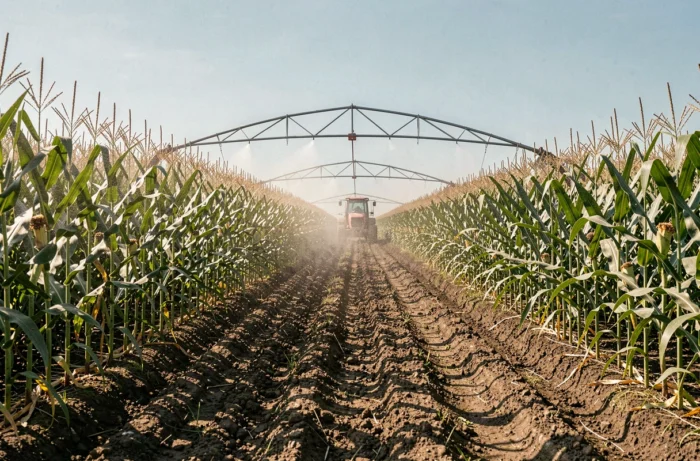
On many grain farms, the pivot or reel operates in the middle of the afternoon, sometimes in temperatures exceeding 35 °C. Motorists are surprised, social media is outraged, and the question arises every summer: why irrigate corn in full sun when it is repeated everywhere that watering should be prioritized in the evening or morning? The answer lies in technical, regulatory, and agronomic constraints that common sense does not cover.
Flow Constraints and Water Turns on Collective Networks
On the ground, one does not always choose their irrigation slot. Most irrigators connected to a collective network operate under water turns imposed by the manager. Each operator has an assigned time slot, sometimes during the day, and must use it or risk losing their right for the next rotation.
The available flow in the pipes drops as soon as several irrigators draw at the same time. Shifting everyone to night or early morning would create a demand peak incompatible with the network’s sizing. This would result in insufficient pressures and irregular watering coverage, leading to real water waste.
Many farmers practice irrigating corn in full sun not out of negligence, but because their slot falls between 10 AM and 5 PM. Refusing this time frame would mean not irrigating at all during a phase when the crop biologically needs it.
The reel, the most common system for large plots, takes several hours to cover its strip. Starting a rotation in the evening does not guarantee that watering will be completed before sunrise. The complete cycle of a reel often exceeds twelve hours, making the idea of exclusively nighttime irrigation unrealistic.
Corn Flowering and Water Stress: Why Every Hour Counts
Corn is a summer crop whose most sensitive period to water shortage corresponds precisely to the hottest weeks. Around flowering, a water deficit of just a few days can compromise seed fertilization and significantly reduce the harvest.
Waiting for the coolness of the evening when the plant shows signs of stress (leaf curling, wilting) means accepting irreversible damage to yield. Irrigating immediately, even at 2 PM, protects fertilization better than a late watering on corn that is already suffering.
The soil also plays a role. On permeable soils (sands, gravels), water quickly descends to the roots, and surface evaporation remains a modest fraction of the volume delivered. On these soils, the difference in loss between daytime and nighttime irrigation is much less than one might imagine from their garden.
Actual Evaporation versus Perceived Evaporation
The general public often overestimates evaporation losses in the field. Low-pressure systems and anti-drift nozzles limit droplet dispersion. Water reaches the soil, infiltrates, and reaches the root zone within minutes.
Measured losses during sprinkler irrigation in hot conditions vary according to wind, humidity, and nozzle type. They remain sufficiently controlled so that the agronomic benefit far exceeds the cost of evaporation when the plant is under stress.
Dryness Orders and Regulatory Irrigation Windows
Since the drought guide from the Ministry of Ecological Transition published in May 2023 and amended in July 2026, the management of irrigation restrictions distinguishes several alert levels. Prefectural orders increasingly impose hourly bans on daytime sprinkling, typically between 11 AM and 6 PM, for large crops.
These restrictions push operators to reorganize their water turns. Feedback varies on this point: some departments apply exemptions for crops in critical phases, others do not. In practice, the regulation creates a local mosaic where each farmer must work within the authorized time frames.
- At vigilance level, daytime irrigation generally remains possible without hourly restrictions.
- At alert level, prohibition windows appear, often between 11 AM and 6 PM for conventional sprinkling.
- In crisis, irrigation may be completely suspended, except for targeted exemptions for seeds or young plants on a limited part of the irrigated area.
The framework amended in 2026 allows for targeted relaxations even at crisis level for certain areas and types of crops, under strict conditions. A farmer who irrigates at 3 PM does not necessarily break the law: they may be operating within a window authorized by the order in effect in their department.

Localized Irrigation Systems and Adaptation to Climate Change
The increase in areas where sprinkling is prohibited accelerates the transition to localized systems. Drip irrigation, whether buried or surface, and micro-sprinkling allow for irrigation without hourly constraints, as water is deposited directly at the soil or root level.
The initial investment is heavier than a conventional reel, but these systems offer several operational advantages:
- No hourly restrictions, even during crisis periods, in most prefectural orders.
- Reduction of losses due to evaporation and wind drift, improving the efficiency of every cubic meter delivered.
- Possibility of fertigation (application of fertilizers via the water network), which reduces the number of mechanical passes over the plot.
- Maintaining a constant moisture level in the soil, favorable for root development.
On farms that grow seed corn or grain corn on permeable soils, buried drip irrigation is emerging as the sustainable alternative in response to regulatory tightening. The extra cost is recouped over several seasons due to water savings and operational flexibility.
Water Management at the Watershed Scale
The issue goes beyond the plot. Watershed management organizations distribute volumes among irrigators, communities, and natural environments. A farmer who irrigates during the day uses a quota allocated upstream, not “stolen” water from a neighbor’s tap.
The search for new resources (hillside reservoirs, reuse of treated wastewater) is part of the avenues explored to secure irrigation without increasing pressure on waterways during the summer.
Irrigating corn in full sun results from a trade-off between network constraints, the physiological needs of the plant, and the local regulatory framework. As long as collective water turns and reel cycles impose daytime slots, this practice will remain common. The evolution towards localized systems and more precise volume management is the underlying trend, driven by both regulation and the climatic reality of recent summers.