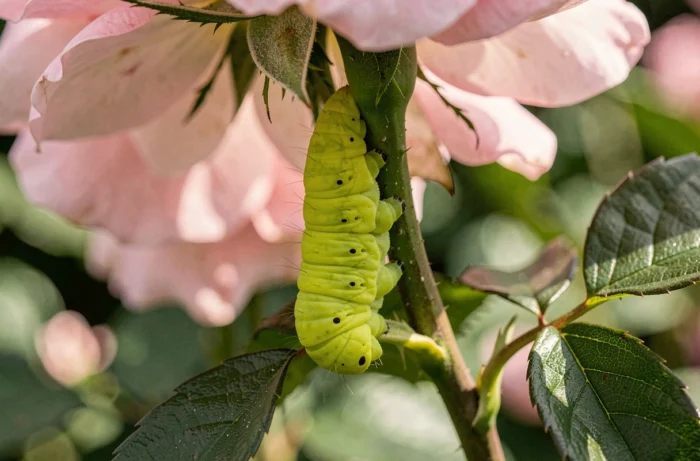
On a rose bush, a small bright green larva that devours the leaves is not necessarily a caterpillar. In most cases, this fluorescent-looking pest is a false caterpillar, meaning it is the larva of a wasp called a sawfly. Confusion is common, and it directly influences the choice of treatment. Correctly identifying the insect before taking action avoids wasting time with unsuitable products.
Counting false legs: the only reliable method on a rose bush
The fluorescent green color is not enough to identify a pest. Several species of lepidopterans (true butterflies) and hymenopterans (sawflies) produce green larvae, sometimes on the same plants. On a rose bush, the probability points towards the sawfly, but it is not an absolute certainty.
The distinguishing criterion is morphological. A true butterfly caterpillar has a maximum of five pairs of abdominal false legs. A false caterpillar of a sawfly has six pairs or more. Gently turning the larva over and observing the ventral side resolves the question in a few seconds.
Other clues complement the identification. Sawfly larvae often stay tightly grouped along the edges of the leaves, with their abdomen raised in an S shape when disturbed. They have neither an anal horn (common in sphinx moths) nor an osmeterium (defensive organ of the swallowtail). A practical guide helps to better treat the fluorescent green caterpillar on rose bushes by systematically crossing the host plant, the type of damage, and the morphology of the larva.
Crossing these three criteria (consumed plant, shape of damage, number of false legs) remains more reliable than any photo recognition app, whose field returns vary on accuracy for small larvae.
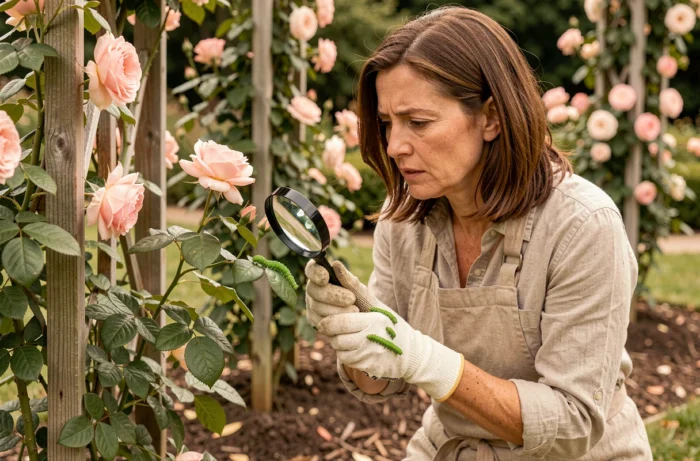
Damage to the foliage of the rose bush: stripping, lacework, or perforation
Sawflies on rose bushes include several species, and each leaves a different signature on the foliage. Recognizing the type of damage points to the responsible species and helps assess the severity of the attack.
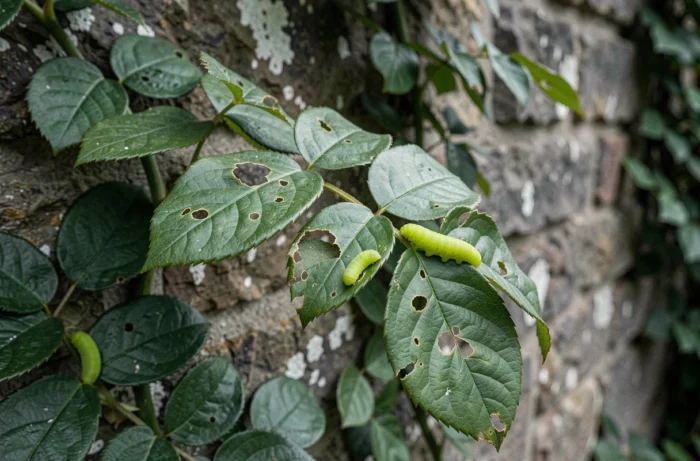
Skeletonized leaves or reduced to the veins
Gregarious larvae strip the leaf blade, leaving only the main veins. This typical pattern corresponds to slug sawflies (Endelomyia aethiops) or species of the genus Arge. The attack progresses rapidly when a group of larvae concentrates on the same branch.
Leaves with irregular perforations
Scattered holes, without mucus traces, indicate solitary larvae. The damage is less spectacular but can spread to the entire rose bush if the population increases.
Leaf curling
Some species of sawflies cause a characteristic curling of the leaf, within which the larva develops in safety. Unrolling the leaf confirms the presence of the pest.
A healthy adult rose bush can tolerate partial defoliation without long-term consequences. However, a young rose bush or a previously weakened subject may experience a noticeable slowdown in growth if the attack is not controlled.
Natural treatments against rose sawflies: what works and what doesn’t
Recent regulatory restrictions on chemical insecticides for individuals (as part of the Ecophyto plan) have reduced the options available in garden centers. Biological solutions are now the norm for amateur gardens.
Manual collection
The most direct method. Sawfly larvae easily detach when branches are shaken over a bucket of soapy water. On an isolated rose bush with a moderate infestation, this technique often suffices to solve the problem.
Biological insecticides based on natural pyrethrins
Plant pyrethrins act by contact on the larvae. Their effectiveness is real, but their residual effect is short, necessitating repeated applications. One point to keep in mind: pyrethrins are not selective and also affect beneficial insects present on the rose bush.
Is Bacillus thuringiensis (Bt) effective against sawflies?
Bt kurstaki, commonly used against butterfly caterpillars, does not act on false caterpillars. This is a direct consequence of the confusion between true and false caterpillars. Bt specifically targets lepidopteran larvae. Since sawflies are hymenopterans, they are not sensitive to it. Applying Bt to sawfly larvae is essentially treating for nothing.
This point is rarely highlighted in public gardening guides, which sometimes recommend Bt without specifying this limitation.
Prevention in the garden: limiting sawfly populations on rose bushes
Acting upstream reduces the need for treatment. A few practices decrease sawfly pressure from one season to the next.
- Work the soil at the base of the rose bushes in late autumn or winter. Sawfly nymphs overwinter in the top few centimeters of soil, and tilling exposes them to natural predators and frost.
- Encourage biodiversity in the garden. Blue tits, hoverflies, and certain beetles actively consume sawfly larvae. Installing nesting boxes and limiting non-selective treatments protects these beneficials.
- Monitor the rose bushes from late spring, the time when the first larvae appear. Early detection allows for manual collection before the population spreads.
Field returns vary on the effectiveness of plant extracts (nettle, tansy) as a preventive treatment against sawflies. Their repellent action has not been formally confirmed for these specific insects, although some gardeners report a deterrent effect.
The confusion between butterfly caterpillars and sawfly false caterpillars remains the main trap when faced with an attacked rose bush. Checking the number of false legs before any intervention determines both the identity of the pest and the appropriate treatment. A well-monitored rose bush from May onward, in a garden that hosts natural predators, rarely suffers serious damage.