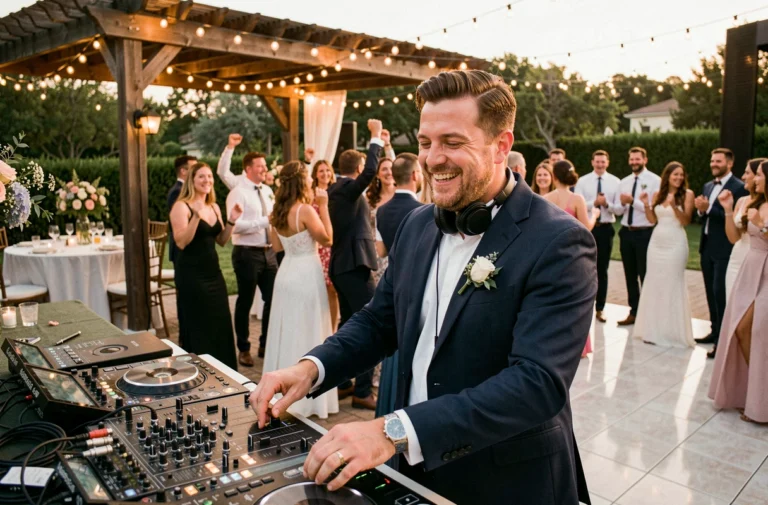
At a family gathering or a wedding, the Madison remains the dance that gets everyone on their feet in just a few seconds. The steady tempo, the line dance steps, and the collective energy are enough to transform an empty dance floor into a moment of sharing. However, it is essential to choose the right tracks and sequence them in the correct order to maintain the momentum from start to finish.
Tempo and rhythmic structure of the Madison: what really makes people dance
Before compiling a list of tracks, it is important to understand why some songs work better than others. The Madison relies on a pattern of regular steps, executed in a line. The ideal tempo is around 120 to 130 BPM, fast enough to provide energy, yet slow enough for everyone to follow without panic.
A song that is too fast desynchronizes the group. A song that is too slow breaks the dynamic. If you are torn between two tracks, tap your foot: the one you naturally walk to without forcing is probably the right choice.
Structure also matters. Tracks with a short introduction and an identifiable chorus allow dancers to find their bearings. A good music selection for dancing the Madison is based on this criterion even before considering the musical style.

Classic Madison tracks that work at every party
Some tracks have stood the test of time and remain safe bets. Their effectiveness is not by chance: they tick all the boxes for tempo, rhythmic clarity, and communicative energy.
Historical pillars
“The Madison Time” by Ray Bryant is the foundational track. Composed in the late 1950s, its moderate swing guides dancers almost naturally. It is often the first song played to kick off a Madison sequence.
“Reviens madison” by Jean-Marc Torchy is among the most played French adaptations in dedicated compilations. Eric Bouvelle with “Sur un air de madison” or “Good Madison” offers an accordion sound that works particularly well in a guinguette or community hall.
Rock and pop tracks adapted for the Madison
You may have noticed that some rock tracks work very well for the Madison, even if they weren’t composed for this dance? “Honky Tonk Woman,” covered by Will Burnett and His Madison Dance Orchestra, is a good example. The binary rock rhythm lends itself naturally to line dance steps.
Jean Harduin offers several tracks specifically designed for the Madison: “Crazy Madison,” “Madison Club,” “Madison City.” These tracks have the advantage of being calibrated in duration and tempo for smooth transitions.
Building a coherent Madison playlist for a wedding or party
Simply stacking tracks is not enough. The order in which you sequence them radically changes the atmosphere on the dance floor.
- Start with a well-known track, like “The Madison Time,” to gather the group and launch the first steps without hesitation.
- Follow up with two or three tracks at a similar tempo to establish a cruising rhythm. Tracks by Jean Harduin or Eric Bouvelle fit this role well.
- End the sequence with a slightly more upbeat track to finish on a high note before transitioning to another dance style.
- Limit the Madison sequence to four or five tracks maximum. Beyond that, even motivated dancers may lose interest.
Four to five well-chosen tracks are better than a dozen played without logic. The Madison works in short, intense waves.

Sound volume in the venue: a legal constraint to integrate into your playlist
This point is rarely addressed in music guides, but it changes the perception of tracks. In France, the broadcasting of amplified music in public venues is regulated by decree n°2017-1244 of August 7, 2017, supplemented by a technical order from April 17, 2023.
The thresholds to be respected are set at 102 dB(A) over 15 minutes and 118 dB(C) over 15 minutes. For events aimed at children under 6 years old, these limits drop to 94 dB(A) and 104 dB(C) over 15 minutes.
Why does this matter for your playlist? A track mixed very loudly in the studio (with a lot of bass, high compression) will reach the legal threshold faster than an acoustic track. An acoustic or semi-acoustic track leaves more volume headroom before triggering a sound limiter, preserving the dynamic on the dance floor.
If your venue is equipped with a limiter (mandatory in many reception halls), test your tracks before the big day. A Madison cut off in the middle by a triggered limiter instantly ruins the atmosphere.
Adapting the choice of Madison songs to the audience present
A Madison at a wedding is not prepared the same way as a Madison at a village party. The audience dictates the repertoire.
For a multigenerational wedding, prioritize classic French songs. Tracks by Jean-Marc Torchy or Eric Bouvelle’s accordion arrangements resonate with guests of all ages. The Anglo-Saxon versions by Will Burnett also work, but they sometimes require a small announcement from the DJ to get the movement started.
For a night among friends or a younger event, you can incorporate rock covers or remixed versions. Energy takes precedence over tradition as long as the tempo remains suitable for the Madison steps.
One last practical point: always prepare a backup track. If the dance floor empties after the second song, it’s better to switch directly to another style than to force three more Madisons in front of empty chairs. The Madison remains a group dance, and without a group, it loses its purpose.