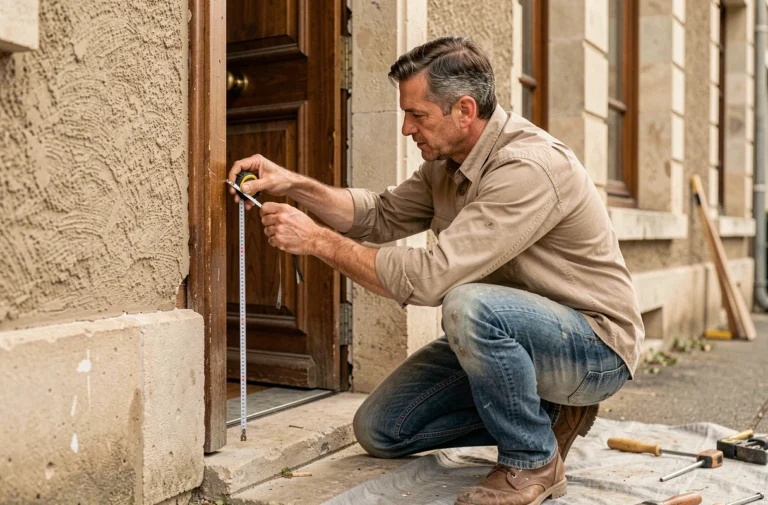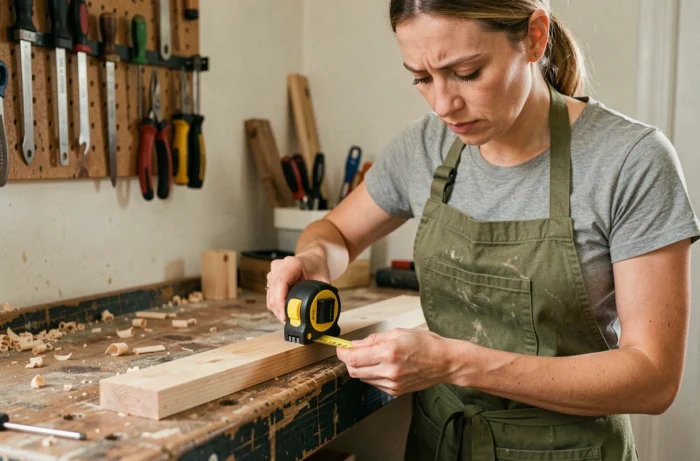
DIY encompasses a set of manual techniques (carpentry, plumbing, basic electricity, painting, laying coverings) that allow for the maintenance or improvement of a home without systematically resorting to a craftsman. For a beginner on a tight budget, the difficulty lies not in the lack of educational resources, but in sorting through free training, online subscriptions, and in-person workshops, whose actual costs vary greatly.
Out-of-pocket expenses for CPF and DIY: what has changed since 2024
Many online resources still mention the possibility of financing DIY courses through the Personal Training Account (CPF) at no cost. The reality in 2026 is different.
Leisure-oriented DIY training, without certification registered with the RNCP or the Specific Directory, is gradually being excluded from the CPF. Only workshops linked to a recognized certification remain eligible.
The mandatory flat-rate contribution for each use of the CPF has increased to 150 euros in April 2026 for individuals, unless covered by an employer or a local authority. For a beginner looking to learn the basics of tile laying or connecting a faucet, this out-of-pocket expense makes the CPF significantly less attractive than advertised. It is better to explore other options before mobilizing this system.
In comparison, specialized platforms offer courses from bricoludik.fr for small budgets in the form of monthly subscriptions, with an annual cost lower than a single in-person workshop funded by the CPF.
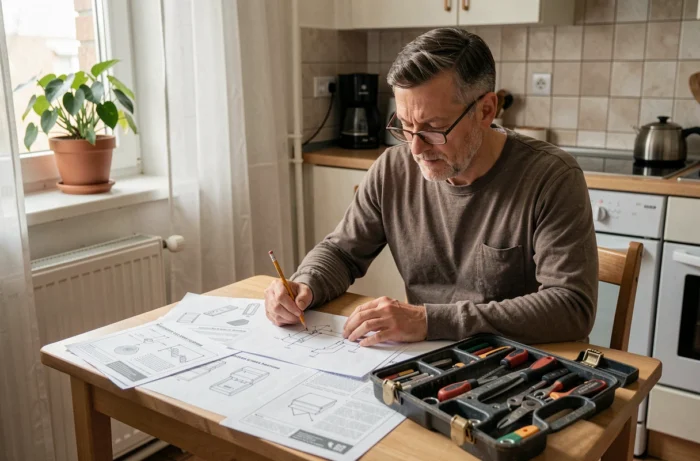
Free in-store workshops: an underestimated format to start
Several DIY retailers in France organize free collective workshops in their stores. These sessions generally last between one and two hours and cover a specific technical gesture: installing a shelf, making a bathroom seal, connecting a socket.
The main advantage of this format is direct access to a trainer and tools, without having to purchase anything beforehand. It’s a good way to test one’s motivation before investing in equipment.
Limitations to know before signing up
- Spaces are often limited and the time slots offered are during the day, making access difficult for full-time employees
- The program is dictated by the retailer and its products, not by the specific needs of the participant
- The level remains very introductory: one learns an isolated gesture, rarely a complete sequence of tasks
To move beyond this stage, a structured course that links techniques in a logical order, from the simplest (measuring, drilling, screwing) to the more specialized (electricity, plumbing), is necessary.
Online DIY subscription platforms: compare before paying
The market for online DIY courses has expanded in recent years. Two models coexist: subscription platforms (unlimited access to a library of videos for a monthly fee) and individual courses with a private trainer.
Monthly subscriptions offer the best value for money for a beginner who wants to progress at their own pace. They allow for reviewing a technical gesture as many times as necessary, which a two-hour in-person workshop does not permit.
Selection criteria for an online DIY platform
- The presence of videos filmed in real conditions (not just animations or diagrams) with a camera angle that shows hands and tools
- A progressive course with modules categorized by level, not just a simple list of tutorials without order
- The ability to ask questions to a trainer, even in writing, to clarify a technical point
- A free trial or a refund period, to ensure that the content matches one’s project
Private home courses, through matchmaking platforms, offer more in-depth personalized support. However, the hourly rate exceeds that of a full month’s subscription, making them suitable for occasional and targeted needs.
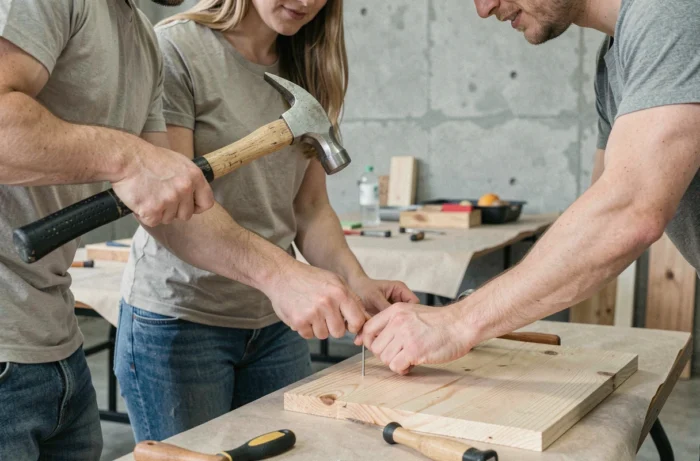
Basic tools to start: buy smart without over-equipping
A common trap for beginners is to buy too many tools before even knowing what project to undertake. Five tools are sufficient for most small daily tasks: a tape measure, a drill-screwdriver, a spirit level, a set of screwdrivers, and a multi-grip pliers.
To limit costs, the second-hand market (garage sales, peer-to-peer resale platforms) allows finding reliable brand drill-screwdrivers at a fraction of the new price. Checking the battery’s condition remains the main point of vigilance: a worn-out battery negates the savings made.
Reuse and tool libraries
Some local authorities and associations offer tool libraries, a tool lending system modeled after a library. This system is particularly suited for specialized tools that are only needed once (circular saw, belt sander, heat gun).
Before purchasing an expensive tool for a one-time project, checking for a local tool library can save several dozen euros. Repair Cafés and recycling centers also guide towards these lending solutions.
First DIY project: choose a low-risk task
The choice of the first project sets the tone for what follows. A failure on an overly ambitious job (rewiring an electrical panel, laying floating flooring in a large room) can lead to lasting discouragement. Conversely, a small successful project builds the technical confidence necessary for progression.
Installing a wall shelf with appropriate anchors for the type of wall (drywall, brick, concrete) is a good first exercise. This project involves measuring, drilling, screwing, and leveling, which are four fundamental gestures found in most subsequent tasks.
Choosing the anchor based on the support is, in fact, the first true technical knowledge of the beginner DIYer. A Molly anchor in drywall is not installed like a hammer-in anchor in solid concrete, and confusing the two guarantees failure under load.
Progressing to painting a room, then to a small plumbing project (replacing a shower hose, installing a self-piercing faucet), allows building a reusable skill base for more ambitious renovations, without ever being entirely dependent on a craftsman for routine interventions.