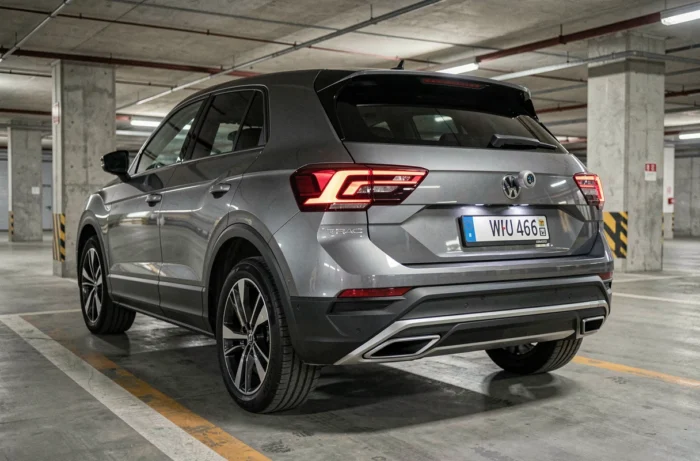
maneuvering a Volkswagen T-Roc in a narrow underground parking lot or along a high sidewalk is the moment when the rearview camera goes from being a gadget to a daily reflex. On the 2026 generation of Volkswagen’s compact SUV, this function is no longer limited to a simple rear display. There is an increasingly advanced integration between cameras, sensors, and parking assistance software, which redefines what is expected from a reversing equipment.
360° Area View on the T-Roc: beyond the digital rearview mirror
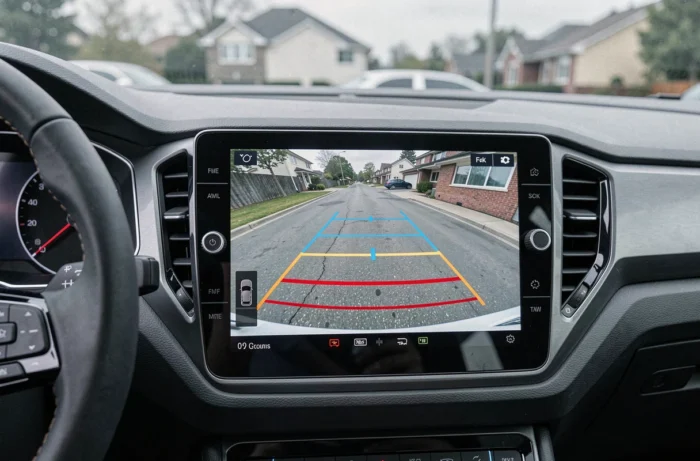
On the first generation T-Roc, the rearview camera displayed a rear video feed with dynamic guiding lines. Useful, but limited as soon as the obstacle was on the side, in the blind spot, or at a low curb.
Volkswagen now offers the Area View option on the new T-Roc, a system that combines four cameras to recreate a complete aerial view of the vehicle. You can see curbs, ground markings, poles, and objects located outside the direct line of sight. In a dense urban environment, this peripheral coverage radically changes the quality of information available during maneuvering.
To follow the 2026 trends for T-Roc rearview cameras and their variations according to trims, the topic deserves a look beyond just the rear feed.
The distinction between a classic rear camera (Rear View) and the panoramic Area View is a structuring choice at the time of configuration. The Rear View remains available on entry-level trims, while the Area View often involves an option package or a higher trim. This segmentation logic by equipment level is found in other markets: in South Africa, for example, the rear camera and Park Assist are offered as standard from the entry-level trim.
Park Assist Plus and remote control: the T-Roc rearview camera as an active component
The rearview camera is often reduced to a passive screen. On the T-Roc 2026, it becomes a sensor among others within a semi-automated parking system.
Park Assist Plus can memorize up to five maneuvers and reproduce them automatically. The vehicle manages steering, acceleration, and braking based on the fusion of camera and ultrasonic sensor data. The driver supervises but no longer intervenes on the steering wheel.
Park Assist Pro takes the logic even further with remote control via the Volkswagen app. Specifically, you can initiate a parking maneuver from outside the vehicle using your smartphone. This scenario is particularly useful when the space between two cars prevents opening the doors.
Three levels of parking assistance to distinguish
- The Rear View camera alone, which displays the rear feed with dynamic guiding lines, without active intervention on steering or braking
- Park Assist Plus, which combines cameras and sensors to reproduce memorized maneuvers semi-automatically
- Park Assist Pro, which adds remote control via the Volkswagen app, allowing parking without being on board
The integration of camera-sensors-software represents the most significant trend. The camera is no longer a screen; it is a decision-making component in a chain that goes from obstacle detection to steering the wheels.
Trims and camera options for the Volkswagen T-Roc 2026: what changes by version
The availability of the rearview camera and its extensions varies significantly depending on the chosen trim level. In the French market, Volkswagen structures its T-Roc range with several levels, and the distribution of parking assistance equipment follows this hierarchy.
On entry-level versions, the Rear View camera is generally found. To access the Area View or Park Assist Plus, you need to upgrade or select a dedicated package. Feedback varies on this point according to dealerships and current offers, but the additional cost of the panoramic view remains a factor to anticipate during configuration.
In terms of engine, the T-Roc 2026 offers a 1.5 eTSI hybrid version with 150 hp and DSG7 transmission. This mild hybridization does not have a direct impact on the camera’s operation, but it alters behavior at low speeds (the engine can cut off during maneuvers), making camera and sensor assistance even more relevant for controlling distances.
European regulation and onboard cameras: what governs usage in 2026
The European Union is gradually imposing advanced driver assistance systems on new vehicles. On the T-Roc, the overlay of visual sensors creates an ecosystem where the rearview camera is just one link in a broader perception network, with exterior cameras participating in obstacle detection and parking assistance.
For owners considering adding an aftermarket dashcam (continuously recording onboard camera), legislation varies by European country. In France, use is permitted, but the dissemination of images is regulated by GDPR. It is advisable to check the compatibility of the dashcam with the T-Roc’s electrical system to avoid interference with the vehicle’s native assistance systems.
Points of caution for complete camera equipment
- Check if the chosen trim includes the Rear View as standard or if it requires an additional package
- Compare the cost of the Area View option to the configuration and on the used market, where some high-end versions already include the system
- Ensure that an added dashcam does not disrupt ADAS sensors (emergency braking, lane departure warning)
The rearview camera market for the Volkswagen T-Roc in 2026 is structured around a simple principle: isolated rear vision gives way to a comprehensive perception system. Between Area View, Park Assist Pro, and European regulatory constraints, the choice of equipment at the time of ordering directly conditions daily maneuvering comfort.
It is better to compare the available packages on the targeted trim than to discover after delivery that a key element is missing.