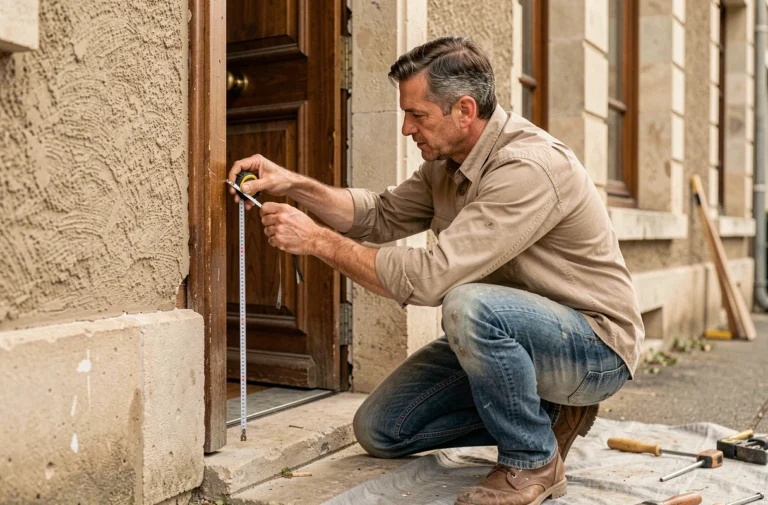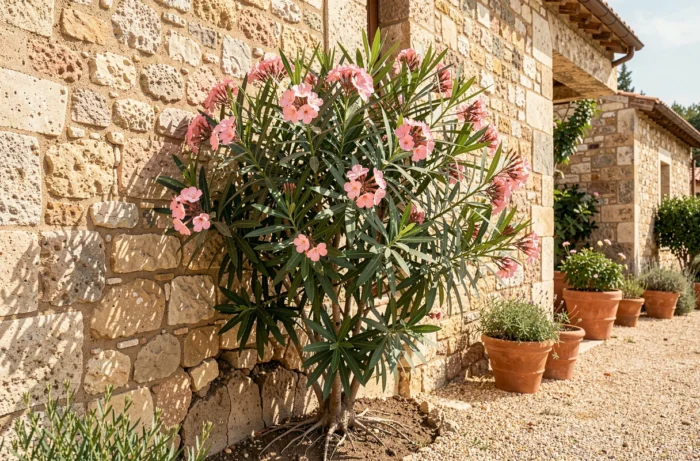
The oleander grows quickly, blooms for a long time, and effectively screens off a view. These qualities make it a common choice along garden walls, facades, and party fences. The problem arises when digging the planting hole: the distance chosen between the oleander and the wall affects both the health of the shrub and the integrity of the masonry and buried utilities.
Status of the wall and local regulations: the real starting point before planting
Most gardening guides focus on botany, but the first question to resolve is legal. Articles 671 to 673 of the Civil Code set a supplementary rule: 0.50 m for plantings under 2 m high, 2 m beyond. This rule only concerns the boundary with the neighboring property, not your own house wall.
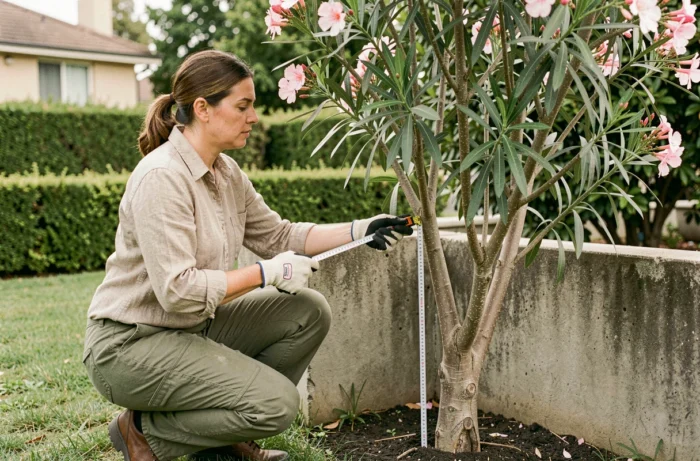
The distance is measured from the center of the trunk at ground level to the boundary line, not from the branches or the fence. A party wall complicates matters: the boundary line runs through the middle of the wall, further reducing the available margin.
These legal distances are supplementary. They only apply in the absence of local regulations or constant usage in the municipality. Before planting, it is necessary to check the local urban planning plan or consult the town hall to see if a different usage prevails. Some Mediterranean municipalities, where oleander is ubiquitous, tolerate shorter distances by tradition.
The question of the distance between an oleander and a wall therefore depends as much on the applicable law as on the nature of the soil or the vigor of the shrub.
Root system of the oleander: real power and misconceptions
The oleander does not appear on lists of species at risk for buildings. The trees actually reported by specialized summaries are the poplar, the weeping willow, the vigorous fig tree, or the running bamboo. The oleander has far less aggressive roots than these species.
Its roots remain relatively shallow and do not develop the penetrating power of a plane tree or a fig tree. However, they are not harmless either. Two situations deserve particular vigilance:
- Clay soil subjected to shrink-swell can amplify the effect of roots near a wall. During dry periods, the roots dry out the clay, which shrinks and causes ground movements capable of cracking a shallow foundation.
- A pipe with a leak (poorly glued, degraded joint) attracts roots due to the moisture it emits. Oleander roots have already penetrated buried pipes, even several meters deep, when a micro-leak existed.
- An old wall without deep foundations or a fence wall made of unreinforced concrete blocks withstands less well the lateral pressure from roots that thicken over the years.
The risk therefore does not come solely from the species, but from the combination of soil, the condition of buried infrastructure, and planting distance.
Planting distance for oleander according to configuration
For a house wall with standard foundations, a minimum setback of 1 to 1.50 m from the center of the trunk constitutes a reasonable compromise. This distance allows the roots the necessary space to develop without exerting pressure on the masonry. It also facilitates maintenance: trimming the back of the shrub becomes possible without scaffolding.
Party wall or fence at the boundary
The legal constraint adds to the technical constraint. If the oleander is kept under 2 m high by regular pruning, the Civil Code allows planting at 0.50 m from the boundary. In practice, this distance generates friction with the neighbors: the persistent foliage quickly overflows to the other side, and the wilted flowers fall onto the adjacent plot.
Planning for at least 1 m at the boundary significantly reduces neighborhood conflicts. This also leaves a margin so that the shrub does not have to be trimmed every month during the growing season.
Proximity to buried pipes
Field reports vary on this point. Some oleanders planted less than a meter from a sewage network have never caused problems after several decades. Others, installed further away, have invaded defective pipes. The determining variable is the tightness of the network, not just the distance.
Before planting, identifying the layout of the pipes (network plan available at the town hall or from the water service) helps avoid positioning the shrub directly above a junction. A setback of 2 m from a known pipe offers sufficient safety in most cases.
Clay soil and shrink-swell: the often-ignored factor
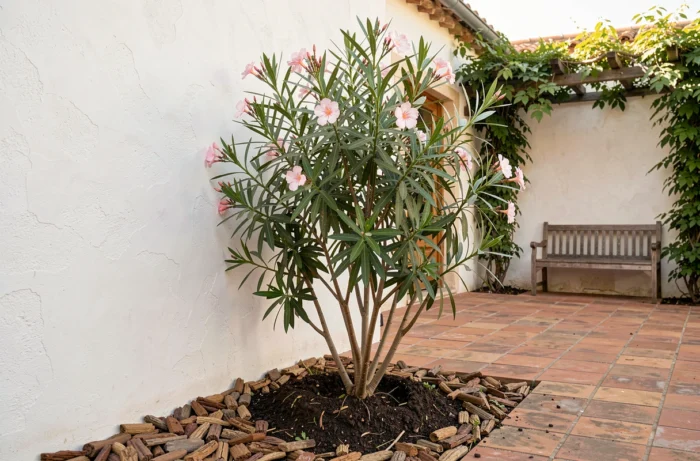
On clay soil exposed to shrink-swell, the presence of any woody plant near a wall can exacerbate ground movements. The oleander, through its summer water consumption, dries out the top layer of clay around its roots. This phenomenon, typical for large trees, also exists on a smaller scale with a vigorous shrub.
Checking the exposure of your plot to shrink-swell risk is possible via the Géorisques website. If the plot is classified as having medium or high exposure, increasing the planting distance to at least 2 m from the wall limits interactions between roots and foundations. Installing a high-density polyethylene root barrier between the shrub and the wall is an additional precaution, but it does not eliminate the need for setback.
Oleander in a pot against a wall: reliable solution or shaky compromise
Planting in a pot seems to solve all distance problems. The roots remain contained, with no interaction with foundations or pipes. The shrub can be placed right against the wall without structural risk.
The limits become apparent over time. A potted oleander requires much more frequent watering than one in the ground, especially in full southern exposure. The substrate depletes in a few seasons and requires regular repotting. Flowering often remains less abundant than that of a plant rooted in the ground.
The pot remains a valid option for a balcony, terrace, or narrow passage where full ground planting is impossible. For a hedge along a garden wall, planting in the ground with an appropriate setback yields better long-term results.
The choice of planting distance hinges on three parameters: the legal status of the wall, the nature of the soil, and the condition of buried networks. No single figure covers all situations, but a setback of at least 1 m for a house wall and 2 m for a pipe covers the vast majority of configurations encountered in residential gardens.