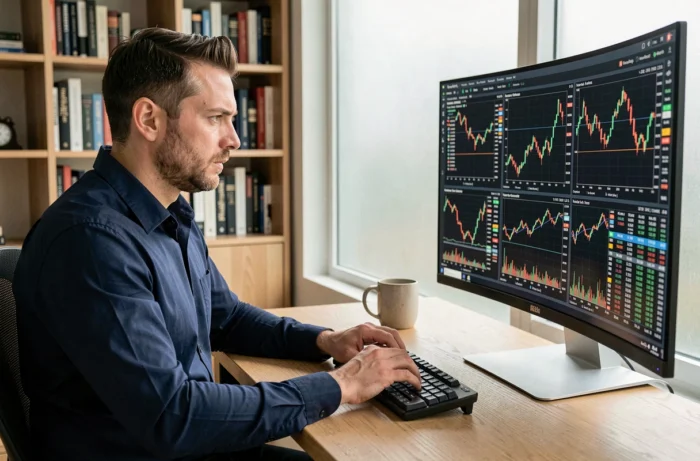
Following stock market news online is not just about opening an information feed in the morning. The quality of the tracking depends on the sources used, the configuration of the tools, and the ability to filter out noise. Here, we detail concrete methods to structure an effective watch on stock markets, ETFs, and indices.
Filtering Social Media Noise on CAC Stocks and Beyond
The AMF 2025 Barometer on the influence of social media provides a clear observation: individuals react to the volume of messages published, not their tone. The more a stock is commented on X (formerly Twitter) or in financial communities, the more it generates transactions, regardless of whether the opinions are positive or negative.
This volume bias exposes investors to impulsive decisions. We recommend never treating a spike in mentions as a buy or sell signal. A stock that is “trending” on social media reflects collective attention, not fundamental analysis.
On the demographic side, the same AMF study indicates that about 10% of 25-34 year-olds get their information from influencers or online financial communities. This channel is gaining traction but remains a minority compared to specialized sites and brokerage platforms. To cross these flows with reliable market data, we regularly consult stock market information on Web Finance, which aggregates prices, analyses, and news without the clutter of discussion threads.
Three Practical Filters to Use X Without Suffering the Noise
- Create private lists limited to identified analysts (fund managers, sell-side strategists) rather than following generic hashtags like #bourse or #trading.
- Ignore any message that does not cite a primary source (annual report, earnings release, Euronext data). An opinion without a verifiable reference has no decision-making value.
- Limit consultations to two fixed time slots per day to avoid continuous scrolling, which leads to overreacting to micro-news.

Stock Market Monitoring Tools: Set Up Alerts Instead of Scrolling
Most retail investors check their broker or a financial portal several times a day. This habit is counterproductive. A well-configured alert system effectively replaces manual monitoring of prices.
Platforms like Boursorama, Zone Bourse, or Bourse Direct offer alerts via email or notifications on price thresholds, percentage changes, or earnings releases. Fine-tuning the settings makes a difference: an alert on a 3% intraday change is more valuable than a daily alert on the closing price.
Beyond Price Alerts: Event Flows
Price alerts are not enough to track market trends. We observe that the most reactive investors combine three types of flows:
- Quarterly and annual earnings flows, available on Euronext Live or directly on the issuers’ websites.
- Macroeconomic calendar (ECB decisions, inflation releases, employment figures), accessible on brokerage portals or aggregators like Zone Bourse.
- Sell-side analyst recommendation flows, published in near real-time on sites like Investir Les Echos, which help identify consensus changes on a stock.
Configuring these three flows in an RSS aggregator or in your broker’s native notifications transforms passive monitoring into structured oversight.
Technical Analysis and Fundamental Analysis: Cross-Referencing Online Frameworks
Following stock market news without an analytical framework amounts to accumulating noise. Fundamental analysis assesses the financial health of an issuer, while technical analysis identifies entry and exit points on a price chart. The two approaches complement each other; they do not oppose one another.
For fundamental analysis, annual reports and investor presentations remain the primary source. Sites like Zone Bourse or Morningstar offer summary sheets (P/E ratio, dividend yield, revenue growth) that allow for a quick initial sorting before reading the reference document.
For technical analysis, the charting tools integrated into online brokers have significantly improved. Moving averages, RSI, volumes: these indicators are now accessible without third-party subscriptions. A common pitfall is to multiply indicators on the same chart. Two or three well-mastered indicators are better than ten overlapping ones that generate conflicting signals.
Monitoring ETFs and Indices: A Distinct Watch from Individual Stocks
Monitoring ETFs does not work the same way as monitoring stocks. An ETF replicating the CAC 40 or the MSCI World does not react to an isolated profit warning. Its performance depends on macroeconomic flows, sector rotations, and monetary policy decisions.
We recommend clearly separating monitoring tools. For ETFs, the macroeconomic calendar takes precedence. ECB decisions on rates, inflation releases in the eurozone, or U.S. employment figures have a direct impact on indices.
For individual stocks, it is the micro flow (earnings, guidance, analyst recommendations) that dominates. Mixing the two in the same dashboard creates confusion and leads to poorly calibrated trades.

Building an Effective Monitoring Dashboard
A useful dashboard separates three columns: ETF positions with their benchmark indices and the next relevant macro event, stock positions with the date of the next earnings report, and a “watchlist” column for stocks under observation. This simple structure prevents useful information from being drowned in an excess of data.
The sustained increase in retail activity in the markets since 2020, documented by the AMF, is accompanied by a multiplication of information sources. This abundance is only an advantage if it is channeled. An investor who consults three reliable sources with configured alerts makes better decisions than one who continuously refreshes ten tabs.